Try, learn and adjust
Check residents can review spending and submit requests
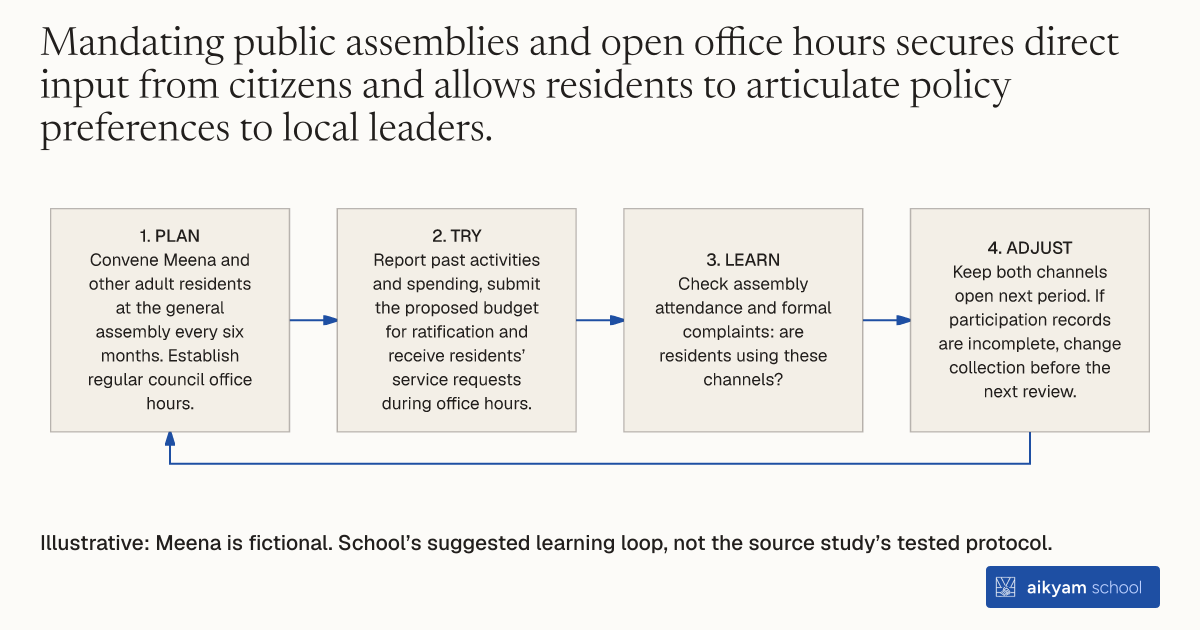
- Plan: Convene Meena and other adult residents at the general assembly every six months. Establish regular council office hours.
- Try: Report past activities and spending, submit the proposed budget for ratification and receive residents’ service requests during office hours.
- Learn: Check assembly attendance and formal complaints: are residents using these channels?
- Adjust: Keep both channels open next period. If participation records are incomplete, change collection before the next review.
Illustrative: Meena is fictional. School’s suggested learning loop, not the source study’s tested protocol.
See source →School’s suggested learning loop: observe attendance, budget ratification and complaints; do not infer that all residents are represented.
How
When to use
Local council leaders often make public expenditure decisions without direct input from residents. Citizens, especially women and marginalized groups, lack formal channels to articulate development priorities or request services. Mandatory assemblies and open office hours create direct governance platforms for rural community members.
Establish mandatory general assemblies and formal office hours to collect citizen input and ratify village council decisions.
- Village council leaders convene a general assembly of all adult residents every six months.
- Council leaders present a report on activities and expenditures from the preceding six months.
- Council leaders submit proposed budgets and public works plans to voters for formal ratification.
- Council presidents establish regular office hours at the council headquarters.
- Residents visit during office hours to formally request public services or lodge governance complaints.
Example
In West Bengal village councils, mandatory assemblies and office hours enabled 20% of female council presidents to receive complaints from women in six months, compared to 11% of male presidents.
About the study
Participants
265 village councils (165 in West Bengal and 100 in Rajasthan) serving rural populations of 10,000 residents each.
Study Design
Randomized policy evaluation measuring biannual general assembly attendance and formal complaint logs brought to council presidents across reserved and unreserved councils.
Results
In West Bengal, female council heads increased the fraction of female assembly attendees from 6.9% to 9.8%, while female attendance in Rajasthan assemblies was 20.41% in reserved councils and 24.49% in unreserved councils.