Research steps
Verify wearing and step reports
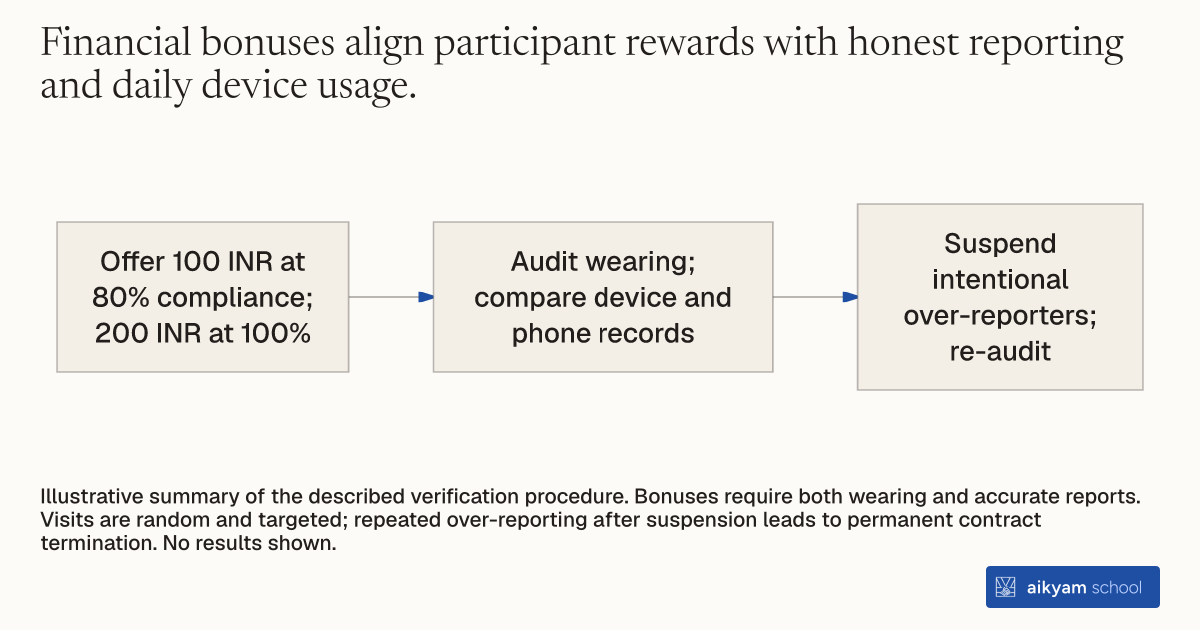
- Offer 100 INR at 80% compliance; 200 INR at 100%
- Audit wearing; compare device and phone records
- Suspend intentional over-reporters; re-audit
Illustrative summary of the described verification procedure. Bonuses require both wearing and accurate reports. Visits are random and targeted; repeated over-reporting after suspension leads to permanent contract termination. No results shown.
See source →How
When to use
Health programs relying on self-reported activity data risk participant misreporting or failure to wear monitoring devices. Financial incentives based on unverified reports can reward falsified step counts. Combining financial compliance bonuses with unannounced audits and suspensions ensures accurate data reporting and maintains program integrity.
Promote accurate self-reporting and device wearing through financial compliance bonuses paired with targeted audits and contract suspensions.
- Offer participants a financial bonus of 100 INR for wearing pedometers and accurately reporting daily step counts on at least 80 percent of program days.
- Provide an additional 100 INR bonus if participants wear pedometers and report steps accurately on 100 percent of program days.
- Conduct random and targeted unannounced in-person visits to check if participants wear their assigned pedometers.
- Sync pedometer data during visits to compare actual recorded steps against self-reported phone entries.
- Temporarily suspend participants whose self-reports show intentional over-reporting upon audit.
- Re-audit suspended participants and permanently terminate contracts if repeat over-reporting occurs.
Why it works
Unannounced audits and tiered suspensions deter deliberate step over-reporting without penalizing honest mistakes.
Example
In Coimbatore, Tamil Nadu, India, researchers audited 1,797 participants and offered up to 200 INR in reporting bonuses across a four-week exercise program, detecting only two instances of shared pedometers and maintaining high reporting verification.
About the study
Participants
6,882 enrolled participants aged 30 to 65 (mean age 49, 37% female, 31% diabetic, 32% hypertensive) in urban Coimbatore, Tamil Nadu, India, with 1,797 individuals audited in person.
Study Design
Verification mechanism within an RCT combining a two-tier accuracy and wearing bonus (100 INR for 80% days, 200 INR total for 100% days) with random and targeted in-person audits and temporary or permanent suspensions for repeated over-reporting.
Results
Participants wore pedometers on 83% of contract days, pedometer data confirmed self-reports on 86.2% of incentivized days (statistically indistinguishable from 88.7% in unincentivized monitoring), and auditors observed only 2 cases of pedometer sharing among 1,797 audited individuals.