Research steps
Choose a balanced random assignment
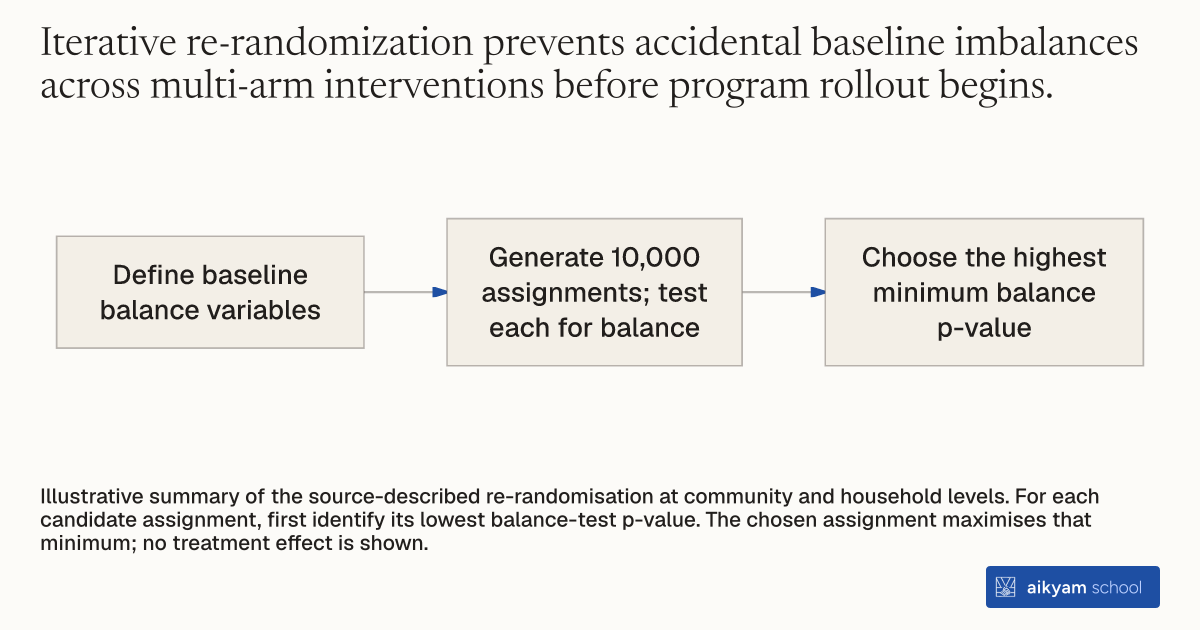
- Define baseline balance variables
- Generate 10,000 assignments; test each for balance
- Choose the highest minimum balance p-value
Illustrative summary of the source-described re-randomisation at community and household levels. For each candidate assignment, first identify its lowest balance-test p-value. The chosen assignment maximises that minimum; no treatment effect is shown.
See source →How
When to use
Complex multi-arm field experiments risk baseline imbalance across treatment and control arms when using simple randomization. Organizations need a systematic method to ensure baseline covariate balance across communities and households. This protocol optimizes treatment assignments before field implementation to maximize statistical balance.
Execute a re-randomization stratification procedure to assign study units across treatment arms with optimal baseline balance.
- Define a vector of baseline balance variables at the community, household, and individual levels.
- Generate 10,000 predetermined random treatment assignments across study units.
- Calculate baseline balance test p-values across all defined balance variables for each generated iteration.
- Identify the minimum p-value among baseline balance tests within each assignment iteration.
- Select the single randomization assignment that maximizes the minimum p-value across all tested balance variables.
Why it works
Selecting the iteration that maximizes the minimum p-value ensures balanced covariates across all study arms.
Example
Innovations for Poverty Action executed 10,000 baseline re-randomization iterations to assign 258 Ghanaian communities and eligible households to pure control, pure therapy, and full program arms.
About the study
Participants
258 rural communities and 7,445 adults from poor households across 14 districts in Ghana.
Study Design
Two-stage re-randomization procedure executed 10,000 times at both community and household levels, selecting the iteration with the maximum minimum p-value across baseline covariates.
Results
Achieved baseline statistical balance across communities and individuals, supporting unbiased estimation of a 0.15 standard deviation mental health gain and a 0.19 standard deviation economic status improvement.