Research assignment
Assign by day of birth
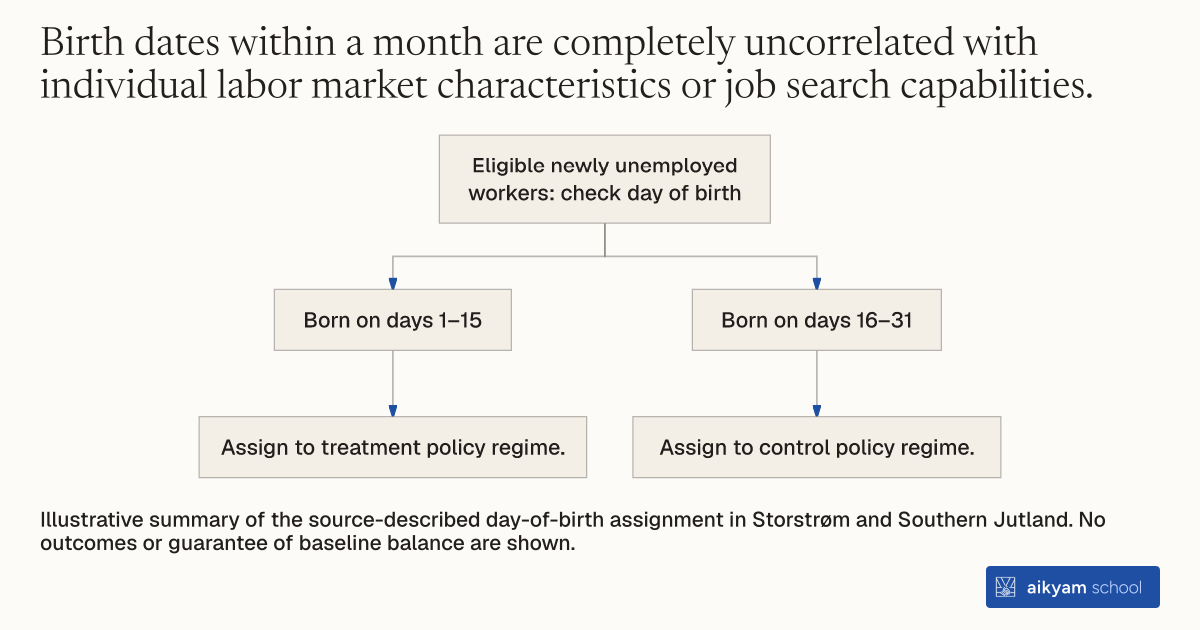
Eligible newly unemployed workers: check day of birth
- Born on days 1–15
- Assign to treatment policy regime.
- Born on days 16–31
- Assign to control policy regime.
Illustrative summary of the source-described day-of-birth assignment in Storstrøm and Southern Jutland. No outcomes or guarantee of baseline balance are shown.
See source →How
When to use
Evaluating active labor market interventions requires unbiased assignment of participants to policy regimes. Assigning job seekers by date of birth solves selection bias by creating comparable treatment and control groups at trial entry. Public employment agencies use this method during large-scale field experiment trials.
Randomize unemployed workers into treatment and control policy groups based on their day of birth within the month.
- Public employment agency staff identify all eligible individuals entering open unemployment during the trial registration period.
- Case workers check the day of the month on which each unemployed worker was born.
- Case workers assign individuals born on the 1st through the 15th day of the month to the treatment group.
- Case workers assign individuals born on the 16th through the 31st day of the month to the control group.
- Employment officers administer the designated policy regime to each group based on their assigned birth date status.
Why it works
Randomizing by birth date ensures that treatment and control groups have identical observed and unobserved baseline distributions at entry.
Example
Public job centers in Storstrøm and Southern Jutland assigned 5,180 newly unemployed workers into treatment and control groups based on birth dates between November 2005 and February 2006. The randomization created balanced baseline groups, with males comprising 62% of treatment and 60% of control in Storstrøm, and 54% across both groups in Southern Jutland.
About the study
Participants
N = 4,513 unemployed individuals across Storstrøm and Southern Jutland counties, Denmark.
Study Design
Randomized controlled trial assigning job seekers by birth date (1st–15th = treatment, 16th–31st = control) evaluated using parametric duration models.
Results
Date-of-birth assignment established balanced control variables across groups and enabled non-parametric identification of a 20% to 40% increase in unemployment exit rates for the treatment group.