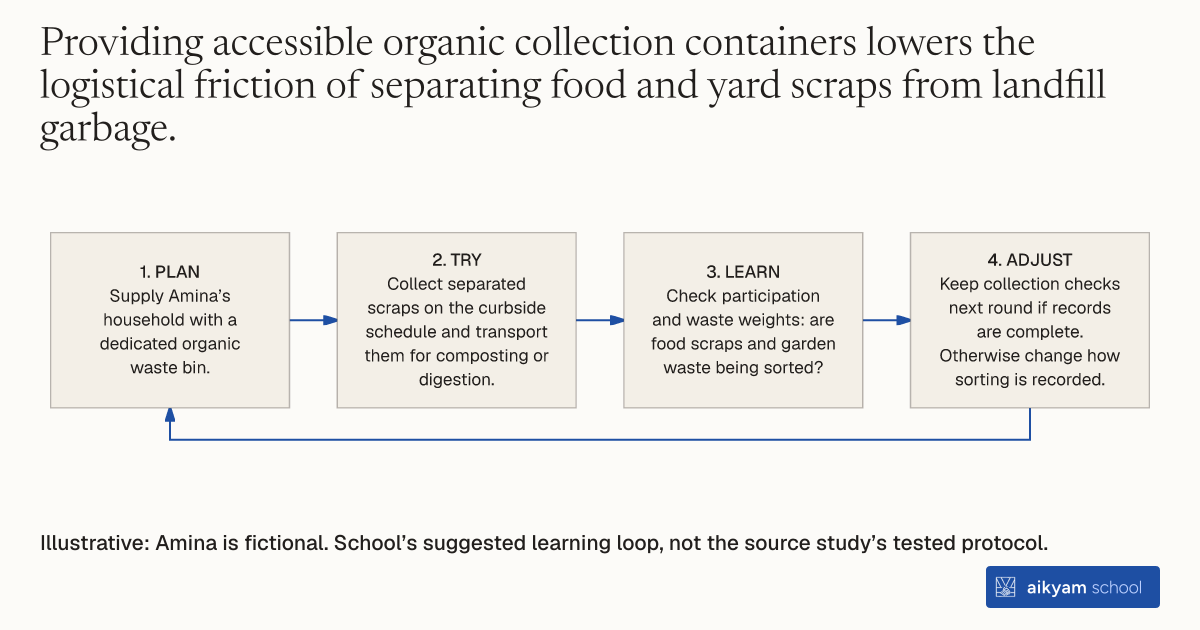
Try, learn and adjust
Check household waste sorting
- Plan: Supply Amina’s household with a dedicated organic waste bin.
- Try: Collect separated scraps on the curbside schedule and transport them for composting or digestion.
- Learn: Check participation and waste weights: are food scraps and garden waste being sorted?
- Adjust: Keep collection checks next round if records are complete. Otherwise change how sorting is recorded.
Illustrative: Amina is fictional. School’s suggested learning loop, not the source study’s tested protocol.
See source →School’s suggested, untested learning loop. Observe participation, sorted organic waste and unsorted trash. Garden-waste gains need not mean food-scrap gains.
How
When to use
Municipalities face elevated landfill methane emissions generated by decomposing organic food and yard waste. Unsorted residential trash streams mix compostable organic material with non-organic garbage. Providing dedicated organic waste bins enables households to separate compostable materials from unsorted solid waste.
Distribute dedicated organic waste bins to residential households to encourage organic waste sorting and community composting.
- Identify target residential neighborhoods and municipal organic waste collection zones.
- Supply dedicated organic waste bins and scrap collection containers to residential households.
- Establish regular curbside organic waste pickup schedules alongside existing garbage services.
- Transport collected organic material to local composting facilities or anaerobic digestion units.
- Monitor household participation, sorted organic waste weights, and unsorted trash reductions.
Why it works
Dedicated bins serve as a constant visual prompt at home, reminding residents to divert compostable materials.
Example
Municipal programs in England and Texas supplied dedicated organic waste bins to residential households to increase composting. Evaluators found that supplying organic waste bins generally reduced unsorted solid waste and increased sorted organic collection, though in some cases effects were limited to organic garden waste or showed minimal impact near landfill methane capture infrastructure.
About the study
Participants
Residential households across England and Texas in the United States across two evaluations.
Study Design
Randomized controlled trial and quasi-experimental evaluations measuring unsorted solid waste weights and sorted organic waste volumes.
Results
Supplying organic waste bins generally reduced unsorted waste and increased sorted waste diversion. However, in some instances, increases were limited to organic garden waste rather than food scraps, and programs yielded minimal additional impact in jurisdictions already operating landfill methane capture facilities.