Try, learn and adjust
Check waste quantities and billing
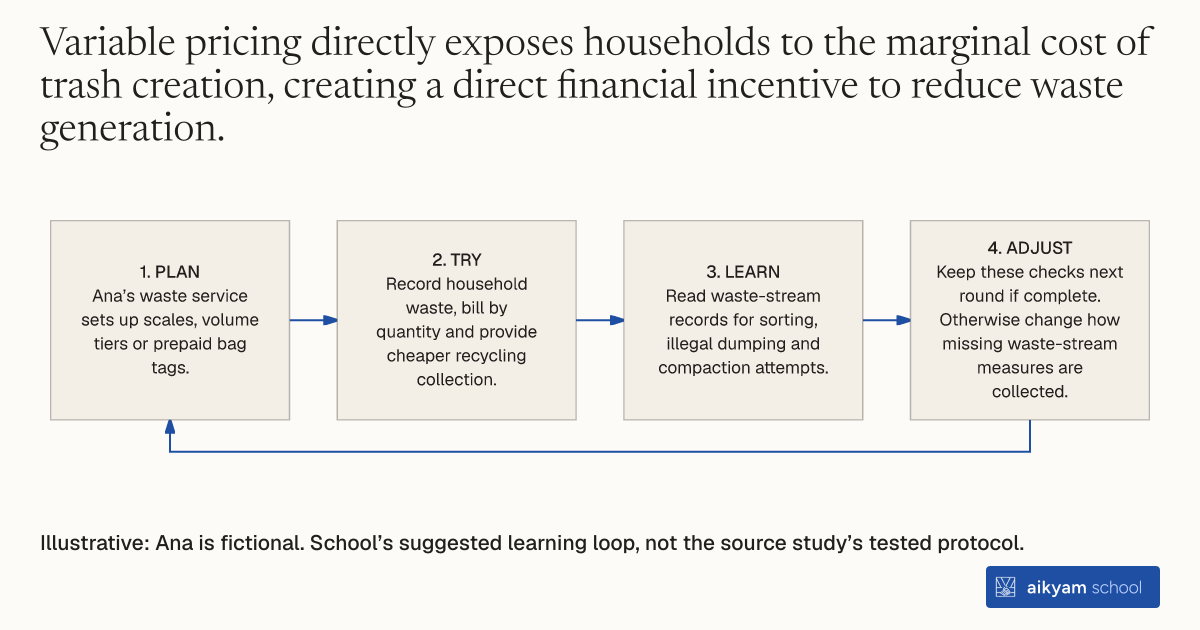
- Plan: Ana’s waste service sets up scales, volume tiers or prepaid bag tags.
- Try: Record household waste, bill by quantity and provide cheaper recycling collection.
- Learn: Read waste-stream records for sorting, illegal dumping and compaction attempts.
- Adjust: Keep these checks next round if complete. Otherwise change how missing waste-stream measures are collected.
Illustrative: Ana is fictional. School’s suggested learning loop, not the source study’s tested protocol.
See source →School’s suggested, untested learning loop. Observe recorded waste, quantity-based charges, recycling, dumping and compaction.
How
When to use
Flat-rate waste disposal fees obscure the marginal cost of garbage generation, leading households to produce excessive unsorted trash. Municipalities lack effective financial mechanisms to incentivize household waste sorting and recycling. Unit-based pricing solves this by charging households according to the actual volume or weight of garbage produced.
Charge residential households variable rates based on the measured quantity of unsorted solid waste disposed.
- Municipal waste departments establish container tracking systems using weight scales, container volume tiers, or prepaid bag tags.
- Sanitation workers record individual household waste volume or weight during scheduled curbside collection rounds.
- Utility billing systems calculate variable disposal charges proportional to each household's recorded waste output.
- Municipalities provide free or low-cost curbside recycling bins to enable waste diversion away from paid garbage collection.
- Program staff monitor municipal waste streams to detect and address illegal dumping or waste compaction attempts.
Why it works
Households respond by sorting recyclables into free collection streams to shrink their monthly garbage bills.
Example
Municipalities across the Netherlands implemented weight-based, volume-based, and bag-tag pricing systems for household trash collection. Weight-based pricing proved most effective because it prevented residents from compacting garbage to avoid volume fees.
About the study
Participants
Residential households across municipalities in the Netherlands, Italy, Switzerland, and Japan.
Study Design
Quasi-experimental studies utilizing difference-in-differences and synthetic control strategies comparing unit-pricing structures to flat-rate fees across six impact evaluations.
Results
Unit-based pricing schemes produced statistically significant, persistent reductions in unsorted solid waste and increased sorted recycling rates across all studied municipal jurisdictions.