Research steps
Record marital changes since HIV testing
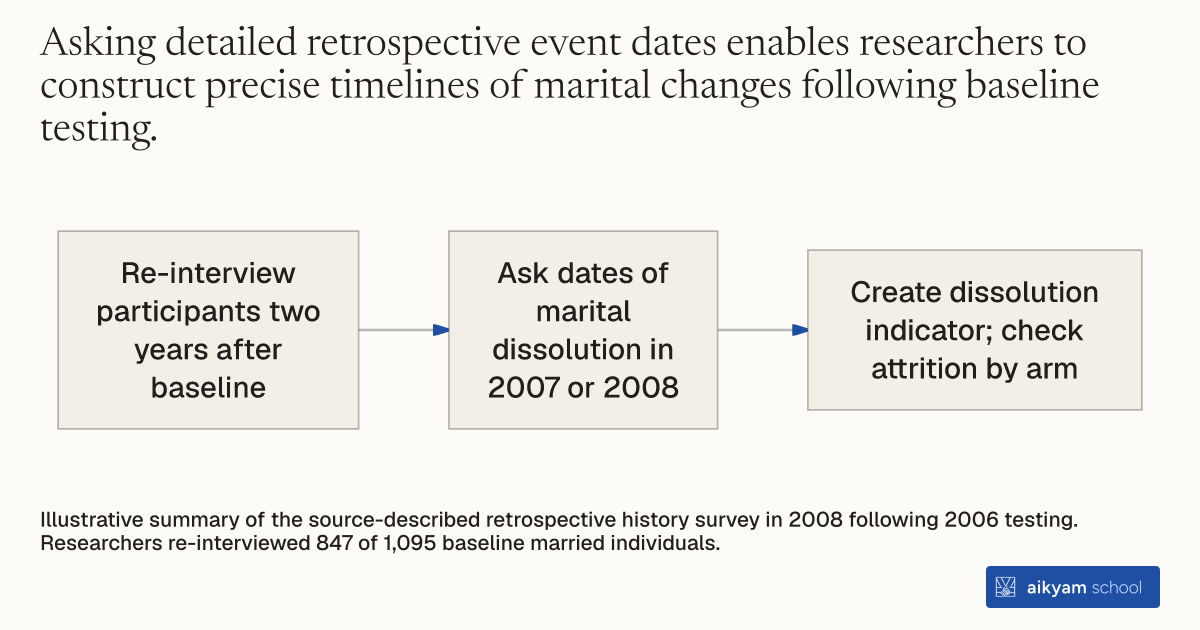
- Re-interview participants two years after baseline
- Ask dates of marital dissolution in 2007 or 2008
- Create dissolution indicator; check attrition by arm
Illustrative summary of the source-described retrospective history survey in 2008 following 2006 testing. Researchers re-interviewed 847 of 1,095 baseline married individuals.
See source →How
When to use
Longitudinal health interventions need to measure relationship outcomes like divorce or separation over extended follow-up periods. Standard cross-sectional surveys often miss short-term marital changes or timing between intervention and breakup. A retrospective marital history survey tracks marital dissolution systematically across follow-up survey waves.
Administer structured retrospective marital history questionnaires to trial participants during longitudinal follow-up visits.
- Survey enumerators locate and re-interview study participants two years after the baseline intervention.
- Enumerators administer a detailed retrospective marital history module asking respondents about changes in marital status.
- Surveyors record exact timing of any marital dissolution occurring in either 2007 or 2008 following the 2006 testing.
- Program analysts construct a binary indicator variable for marital dissolution since baseline.
- Econometricians test for differential attrition across treatment arms to confirm follow-up sample validity.
Why it works
Re-interviewing participants across waves minimizes reporting bias and captures relationship breakups that occurred between survey rounds.
Example
Researchers re-interviewed 847 study participants in rural Malawi two years after baseline to record retrospective marital histories and evaluate divorce rates.
About the study
Participants
847 re-interviewed respondents out of 1095 baseline married individuals in rural Malawi.
Study Design
Longitudinal follow-up survey conducted two years post-baseline using OLS regression models to analyze retrospective marital dissolution indicators.
Results
Retrospective history tracking revealed a 3.5 percentage point drop in divorce among couple-tested participants (1.4 percent) compared to individually tested participants (5.1 percent).