Research steps
Recontact a rural survey panel
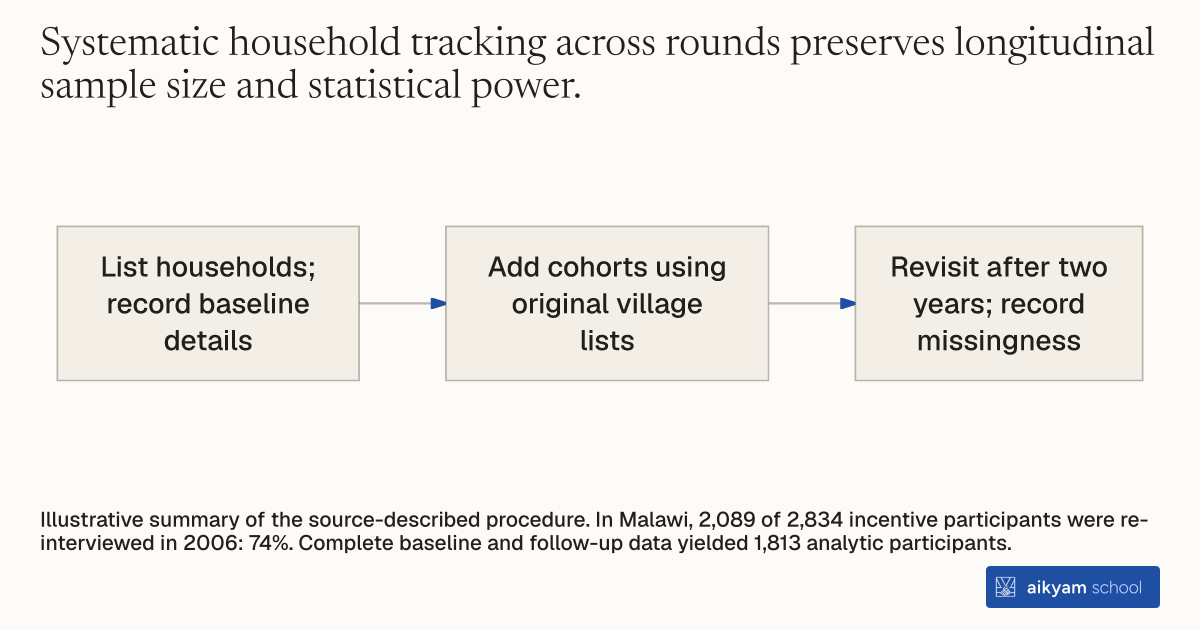
- List households; record baseline details
- Add cohorts using original village lists
- Revisit after two years; record missingness
Illustrative summary of the source-described procedure. In Malawi, 2,089 of 2,834 incentive participants were re-interviewed in 2006: 74%. Complete baseline and follow-up data yielded 1,813 analytic participants.
See source →How
When to use
Longitudinal field studies in rural developing regions suffer from participant attrition over multi-year periods. Recontacting rural households across multiple survey waves requires systematic respondent tracking and village listing. High retention ensures panel data remains representative for evaluating long-term health and economic intervention impacts.
Maintain respondent participation across multi-year panel survey waves through systematic household sampling and field recontacting protocols.
- Field staff map and list households in rural villages to draw a baseline sample of adult residents.
- Field staff record complete baseline demographic, household, and geographic covariates for all enrolled participants.
- Field staff add supplementary demographic cohorts in subsequent survey waves using original village household lists.
- Field staff revisit original study villages two years after initial interventions to locate and re-interview enrolled panel participants.
- Field staff record completion status and reasons for missing respondents to evaluate sample retention and attrition patterns.
Why it works
Re-interviewing original panel respondents enables researchers to track individual behavioral changes over long time horizons.
Example
Researchers in rural Malawi tracked 2,834 respondents enrolled in an HIV testing incentive program in 2004 across 125 villages. Field teams located and re-interviewed 2,089 of these respondents in 2006, achieving a 74 percent follow-up completion rate two years later.
About the study
Participants
2,834 rural Malawian adults across 125 villages enrolled in 2004, with 2,089 re-interviewed in 2006 (41 percent male, average age 35 years).
Study Design
Longitudinal panel survey tracking respondents across baseline (2004) and follow-up (2006) survey waves to measure long-term economic and belief outcomes.
Results
Re-interviewed 74 percent (2,089 out of 2,834) of baseline incentive participants in 2006, yielding an analytic panel sample of 1,813 individuals with complete baseline and follow-up data.