Research procedure
Compare formal requests by gender
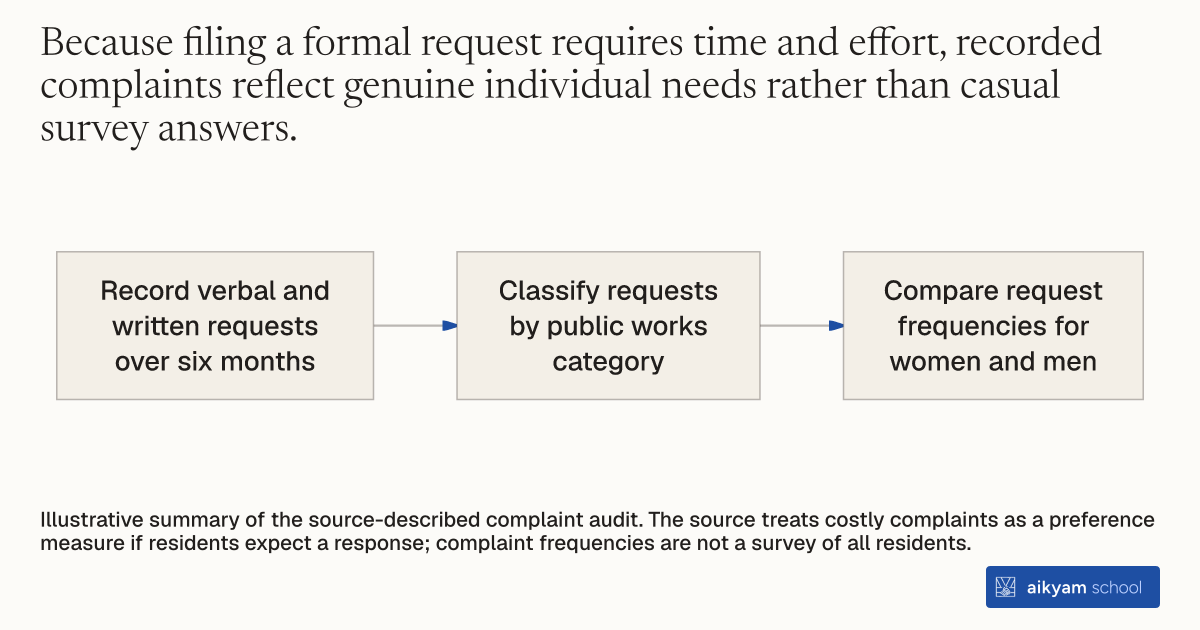
- Record verbal and written requests over six months
- Classify requests by public works category
- Compare request frequencies for women and men
Illustrative summary of the source-described complaint audit. The source treats costly complaints as a preference measure if residents expect a response; complaint frequencies are not a survey of all residents.
See source →How
When to use
Local planners often fail to understand gender-specific priorities because survey responses can reflect socially acceptable answers rather than genuine priorities. This diagnostic method tracks formal complaints submitted directly to elected officials to measure true underlying preferences. It serves policymakers and evaluators who need unbiased preference data to target community investments effectively.
Track and categorize formal citizen complaints lodged during mandatory office hours to measure group-specific policy preferences.
- Direct the local council chief to establish regular office hours where citizens present formal verbal or written requests.
- Record every individual complaint brought by villagers over a six-month observation window.
- Classify each logged complaint ex post into standardized public works categories, such as drinking water, road improvement, housing, electricity, irrigation, and education.
- Calculate the relative frequency of requests for each good separately for female and male residents.
- Compute the percentage difference between female and male complaint frequencies for each good to establish gender-specific preference metrics.
Why it works
The relative frequency of requests across demographic groups provides an unbiased estimate of underlying community trade-offs.
Example
Research teams audited formal requests across village councils in West Bengal and Rajasthan, analyzing 399 total complaints in West Bengal and 160 complaints in Rajasthan.
About the study
Participants
Survey of 265 Village Councils across Birbhum district in West Bengal (399 complaints audited) and Udaipur district in Rajasthan (160 complaints audited).
Study Design
Observational audit of formal complaints brought to village council heads over six months, disaggregated by gender and tested using chi-square distribution checks across reserved and unreserved councils.
Results
In West Bengal, women complained most about drinking water (31%) and roads (31%), whereas men prioritized roads (28%) and irrigation (20%); in Rajasthan, drinking water accounted for 54% of female complaints compared to 49% of male complaints, while roads accounted for 13% of female complaints versus 18% of male complaints.