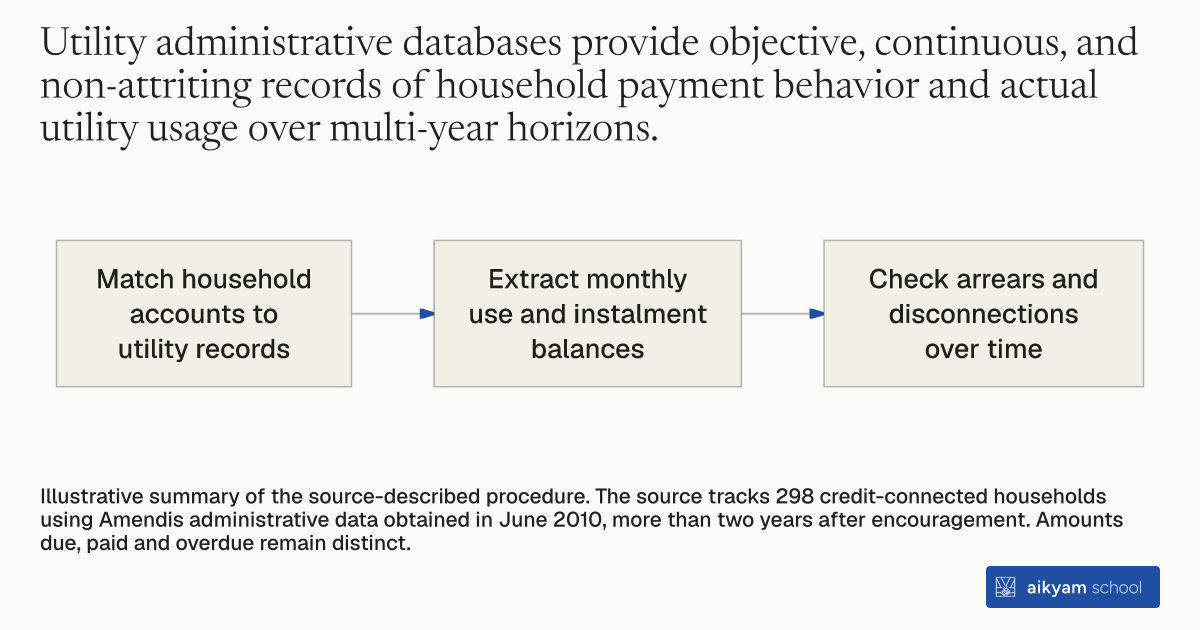
Research steps
Track utility usage and repayment
- Match household accounts to utility records
- Extract monthly use and instalment balances
- Check arrears and disconnections over time
Illustrative summary of the source-described procedure. The source tracks 298 credit-connected households using Amendis administrative data obtained in June 2010, more than two years after encouragement. Amounts due, paid and overdue remain distinct.
See source →How
When to use
Long-term credit programs often suffer from reporting bias or survey attrition when relying solely on self-reported financial data. This method tracks loan default and service utilization directly through centralized utility billing databases. It enables program evaluators to measure actual long-term repayment rates and ongoing service consumption without surveying households again.
Track long-term program compliance and service usage using centralized utility billing databases.
- Researchers obtain administrative billing and customer account records directly from the partner utility company.
- Analysts match participating household account numbers with historical administrative billing databases across multi-year follow-up periods.
- Analysts extract exact monthly water consumption volumes recorded by utility meter readers.
- Analysts calculate loan repayment status by recording total cumulative installments due, paid, and overdue.
- Analysts identify account delinquencies and monitor grid disconnection records to verify default rates over two years.
Why it works
Verifying that households continue paying bills and consuming piped water confirms sustained program demand without self-reporting bias.
Example
In Tangiers, Morocco, researchers obtained historical administrative data from utility operator Amendis in June 2010, more than two years after the initial intervention. Analysis of customer billing records showed that 44 percent of loan recipients had paid all due installments, only 5 percent owed over half their balance, zero households experienced grid disconnections for default, and monthly water usage remained steady without reverting to public taps.
About the study
Participants
298 credit-connected households in Tangiers, Morocco tracked over a two-year period.
Study Design
Longitudinal analysis of utility administrative billing and meter-reading databases to evaluate credit default and consumption dynamics.
Results
Two years post-intervention, 44 percent of credit recipients had repaid all due installments, 28 percent owed under 20 percent of due installments, 5 percent were delinquent on over 50 percent of due payments, zero households were disconnected, and monthly water bills doubled sustainedly from 78 to 147 dirhams.