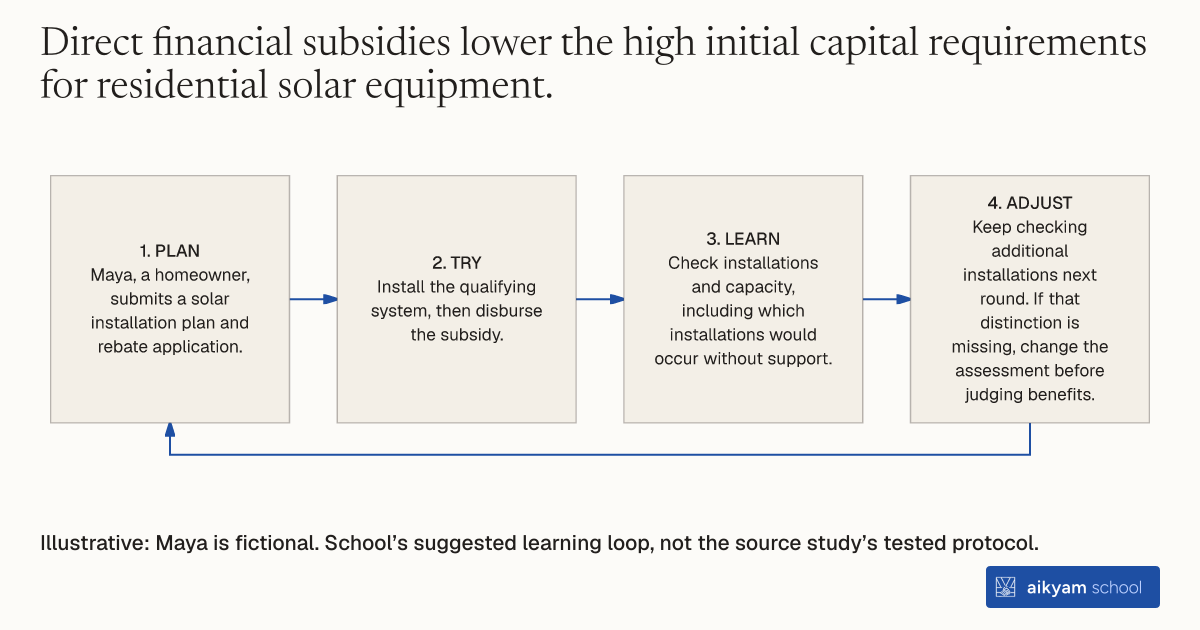
Try, learn and adjust
Check solar rebates and installations
- Plan: Maya, a homeowner, submits a solar installation plan and rebate application.
- Try: Install the qualifying system, then disburse the subsidy.
- Learn: Check installations and capacity, including which installations would occur without support.
- Adjust: Keep checking additional installations next round. If that distinction is missing, change the assessment before judging benefits.
Illustrative: Maya is fictional. School’s suggested learning loop, not the source study’s tested protocol.
See source →School’s suggested, untested learning loop. Observe solar adoption, generation capacity and installations that would happen without a rebate.
How
When to use
Municipalities seek to expand residential clean energy generation to reduce electricity grid carbon intensity. High upfront equipment and installation costs prevent homeowners from adopting rooftop solar panels. Direct rebate and subsidy programs lower these upfront financial barriers for property owners.
Provide financial rebates and incentives to residential property owners installing rooftop solar systems to increase renewable energy capacity.
- Design state or local financial incentive structures, such as the California Solar Incentive program, to lower upfront system costs.
- Accept installation plans and rebate applications submitted by homeowners or qualified solar contractors.
- Disburse financial subsidies directly to qualifying residential property owners upon successful solar panel installation.
- Measure changes in residential rooftop solar adoption rates and total system generation capacity across target municipalities.
- Account for non-additionality where households would have installed panels without public support.
Why it works
Lowering upfront costs accelerates homeowner purchasing decisions and generates local neighborhood peer adoption spillovers.
Example
State and local governments in California and Connecticut offered financial subsidies, such as the California Solar Incentive, to residential homeowners. Program evaluations found that financial incentives successfully increased residential rooftop solar installations across participating communities, though a portion of these installations suffered from non-additionality.
About the study
Participants
Residential property owners across California and Connecticut participating in state and local solar incentive programs, evaluated across 12 impact studies.
Study Design
Two-way fixed effects, regression discontinuity, and difference-in-differences designs measuring rooftop solar adoption and generation capacity.
Results
Solar energy incentive programs increased residential rooftop solar installations and capacity, though a portion of subsidized installations would have occurred without public financial support.