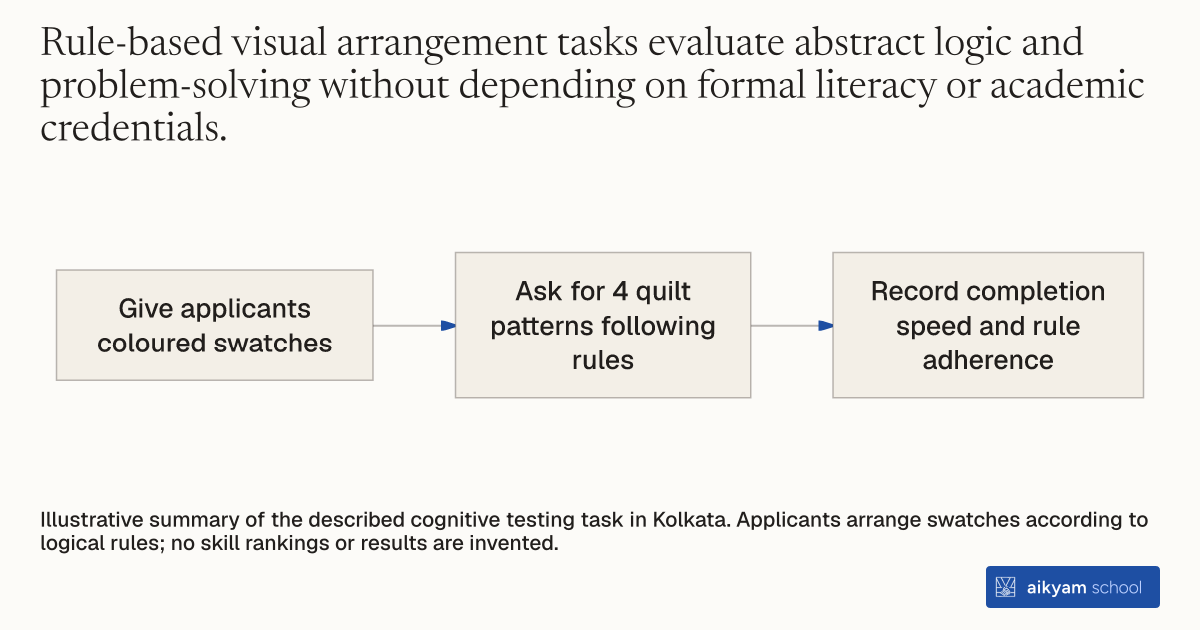
Research steps
Record performance on quilt tasks
- Give applicants coloured swatches
- Ask for 4 quilt patterns following rules
- Record completion speed and rule adherence
Illustrative summary of the described cognitive testing task in Kolkata. Applicants arrange swatches according to logical rules; no skill rankings or results are invented.
See source →How
When to use
In informal labor markets, employers lack formal credentials or work histories to evaluate worker skill. This method tests candidates' cognitive problem-solving ability directly using non-verbal visual tasks. It serves firms and researchers who need an objective measure of applicant capability.
Assess candidate cognitive ability by testing pattern-matching and rule-following performance with visual swatches at a study site.
- Receive adult male job applicants at a local project site.
- Provide candidates with groups of distinct colored swatches.
- Instruct candidates to arrange the colored swatches to design four distinct quilt patterns according to defined logical rules.
- Record each candidate's completion speed and rule adherence as an indicator of cognitive skill.
Why it works
This allows employers to accurately rank worker cognitive ability in informal labor pools.
Example
Researchers in Kolkata, India tested adult male participants on designing four quilt patterns from colored swatches to measure their cognitive ability in an experimental laboratory.
About the study
Participants
562 original participants and 407 referrals (adult males aged 18 to 60) in Kolkata, India.
Study Design
Laboratory RCT where participants completed a rule-based quilt design task along with Raven's matrices and digit span tests.
Results
The cognitive task successfully measured participant skill, revealing that high-ability participants selected high-skilled referrals only when incentivized with performance-contingent pay.