Research procedure
Score timed quilt puzzles
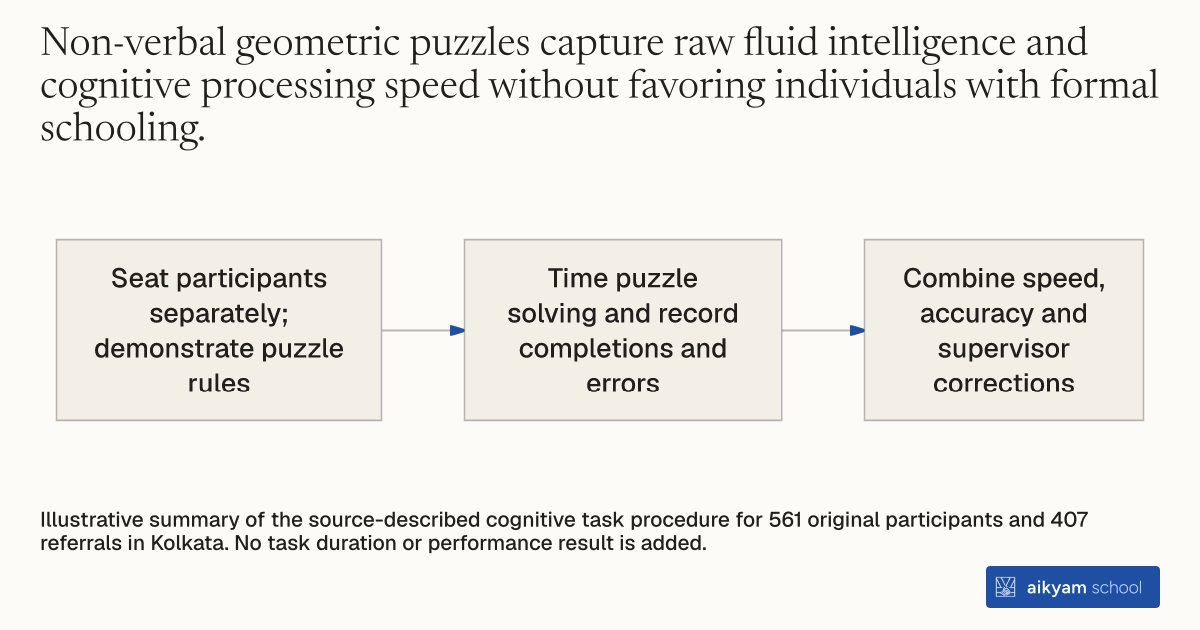
- Seat participants separately; demonstrate puzzle rules
- Time puzzle solving and record completions and errors
- Combine speed, accuracy and supervisor corrections
Illustrative summary of the source-described cognitive task procedure for 561 original participants and 407 referrals in Kolkata. No task duration or performance result is added.
See source →How
When to use
Measure cognitive skill, attention to detail, and problem-solving speed among casual labor market participants using a non-verbal task. This avoids relying on self-reported qualifications or formal education credentials when assessing candidate ability. Use this method when evaluating cognitive productivity in low-literacy or informal labor settings.
Administer a timed rule-based quilt puzzle assembly task to evaluate worker cognitive problem-solving speed and accuracy under standardized supervision.
- Seat participants individually at isolated tables in a quiet work facility.
- Provide a set of geometric quilt puzzle pieces along with visual rules governing correct piece combinations.
- Demonstrate a sample puzzle assembly to ensure understanding of the rules regardless of literacy level.
- Instruct participants to solve as many puzzle boards as possible within a fixed timed session.
- Record total completed puzzles, total time taken per puzzle, and count of incorrect assembly attempts.
- Calculate a composite task performance score standardizing completion speed, accuracy, and required supervisor corrections.
Why it works
Tracking completion times along with incorrect attempts creates a precise measure of worker independence and supervisory overhead.
Example
Field staff evaluated 561 original workers and 407 referred candidates in Kolkata, India, using timed quilt puzzle boards. High-ability workers achieved standardized composite scores 0.371 standard deviations higher when incentivized by performance pay.
About the study
Participants
561 original participants and 407 referrals, adult males in Kolkata, India.
Study Design
Individual timed administration of rule-based pattern puzzles with standardized tracking of puzzle completion time, success, and error count.
Results
Evaluated cognitive productivity across treatment groups, producing a standardized composite score with a mean of -0.009 and a standard deviation of 1.00 that sensitive to peer selection capabilities.