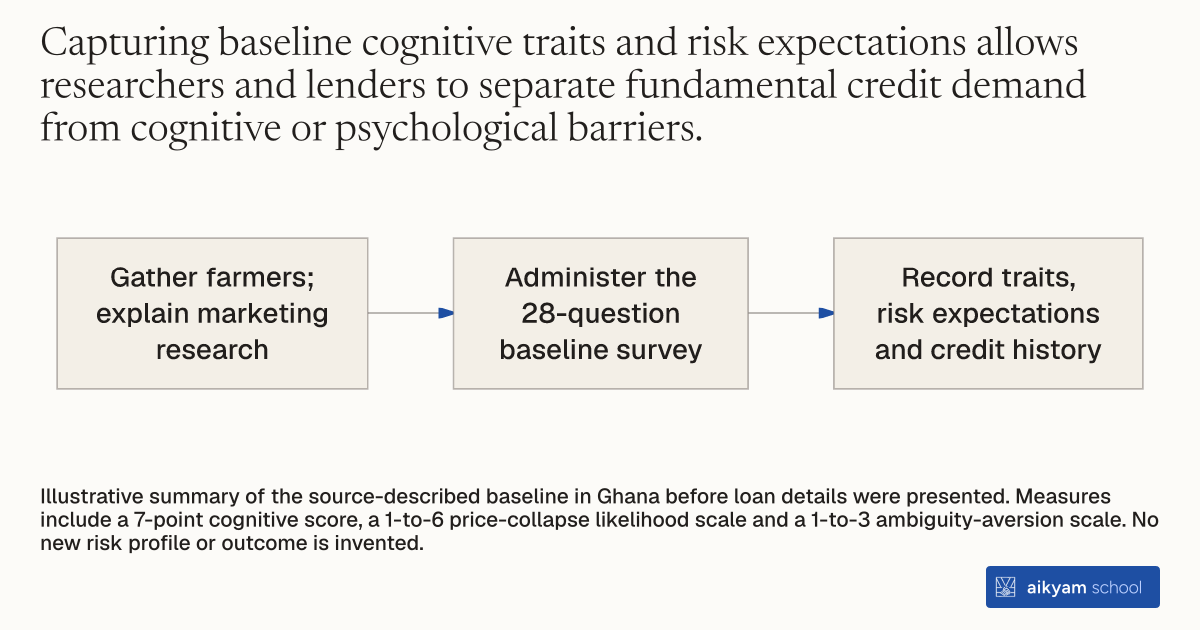
Research steps
Survey farmers before presenting credit offers
- Gather farmers; explain marketing research
- Administer the 28-question baseline survey
- Record traits, risk expectations and credit history
Illustrative summary of the source-described baseline in Ghana before loan details were presented. Measures include a 7-point cognitive score, a 1-to-6 price-collapse likelihood scale and a 1-to-3 ambiguity-aversion scale. No new risk profile or outcome is invented.
See source →How
When to use
This method applies when a financial institution needs to evaluate borrower risk profiles and cognitive capacities before introducing credit products. It solves the challenge of unobserved borrower heterogeneity, such as cognitive ability and risk perception, in smallholder agricultural markets. The approach provides baseline data on smallholders to understand determinants of loan take-up and financial choices.
Administer a structured 28-question baseline survey measuring demographic traits, cognitive ability, risk perception, and credit history prior to presenting loan products.
- Gather target farmers in community group meetings before introducing credit product details.
- Administer a standard questionnaire collecting basic demographic data, including age, gender, education, and household dependents.
- Assess cognitive processing capacity using a standard 7-point cognitive score test.
- Evaluate subjective crop price expectations on a 1-to-6 likelihood scale regarding potential post-harvest price collapses.
- Measure ambiguity aversion using structured preference questions scored on a 1-to-3 scale.
- Record historical borrowing behavior, distinguishing past credit from formal financial institutions versus informal sources.
Why it works
It also verifies that treatment and control groups are balanced on observable traits prior to intervention.
Example
In rural Eastern Ghana, bank employees administered a 28-question baseline survey to 169 smallholder maize and garden egg farmers, establishing average cognitive scores of 4.6 out of 7 and ambiguity aversion scores of 2.3 out of 3 across marketing meetings.
About the study
Participants
169 smallholder farmers (91 maize farmers, 78 garden egg farmers; 126 reached at follow-up) across 5 villages in rural Eastern Ghana.
Study Design
Clustered RCT baseline survey administered across 20 group credit marketing meetings prior to presenting standard or price-indemnified loan offers.
Results
Orthogonality checks confirmed balance across groups (joint F-test = 0.75, p = 0.74); cognitive scores averaged 4.643 out of 7, with higher cognitive scores increasing loan application probability by 4.5 percentage points (p < 0.01).