Try, learn and adjust
Check personal and business money stay separate
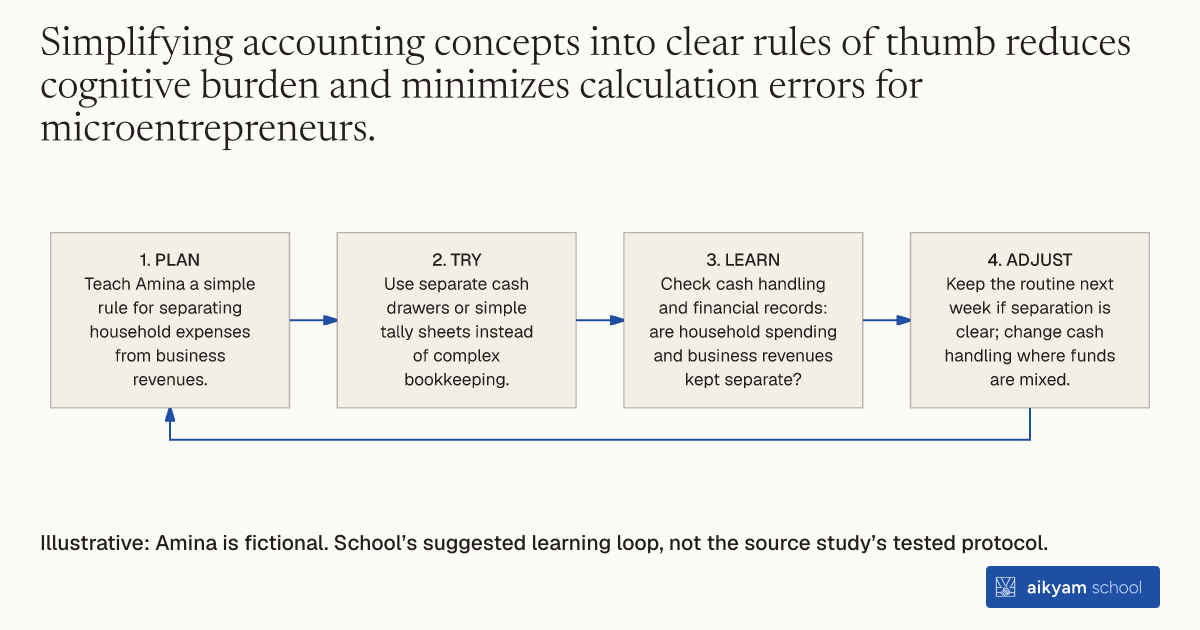
- Plan: Teach Amina a simple rule for separating household expenses from business revenues.
- Try: Use separate cash drawers or simple tally sheets instead of complex bookkeeping.
- Learn: Check cash handling and financial records: are household spending and business revenues kept separate?
- Adjust: Keep the routine next week if separation is clear; change cash handling where funds are mixed.
Illustrative: Amina is fictional. School’s suggested learning loop, not the source study’s tested protocol.
See source →School’s suggested, untested learning loop. Observe cash separation and reporting errors; trial profit gains are not promised for Amina.
How
When to use
Microentrepreneurs with low baseline financial literacy struggle to absorb complex accounting methods taught in traditional training programs. Traditional financial management courses overwhelm business owners with detailed ledgers that are quickly abandoned. Rule-of-thumb training teaches simple heuristics to help low-skilled microentrepreneurs maintain clear financial records.
Teach simplified financial rules of thumb instead of complex accounting procedures to help low-skilled microentrepreneurs manage business finances.
- Instructors identify core financial routines such as separating personal and business finances or calculating daily sales.
- Trainers teach simplified heuristic rules rather than multi-step accounting or double-entry bookkeeping.
- Microentrepreneurs adopt single, easy-to-remember guidelines in their daily business routines.
- Business owners keep physical records using simplified cash management tools like separate cash drawers or simple tally sheets.
- Microentrepreneurs maintain financial separation between household expenses and firm revenues during weekly transactions.
Why it works
These memorable heuristics allow business owners to adopt and sustain key financial practices without requiring extensive mathematical skills.
Example
In Uganda, small enterprise owners received rule-of-thumb financial training, which enabled them to increase business profits by 23.5 percent.
About the study
Participants
Small enterprise owners and microentrepreneurs with low baseline financial skills across the Dominican Republic, Uganda, and Ecuador.
Study Design
Randomized controlled trials evaluating rule-of-thumb financial heuristic training against comparison groups.
Results
Teaching rules of thumb reduced financial reporting errors among low-skilled microentrepreneurs, enabling small enterprise owners to increase profits by 23.5 percent in Uganda and 8.1 percent in Ecuador.