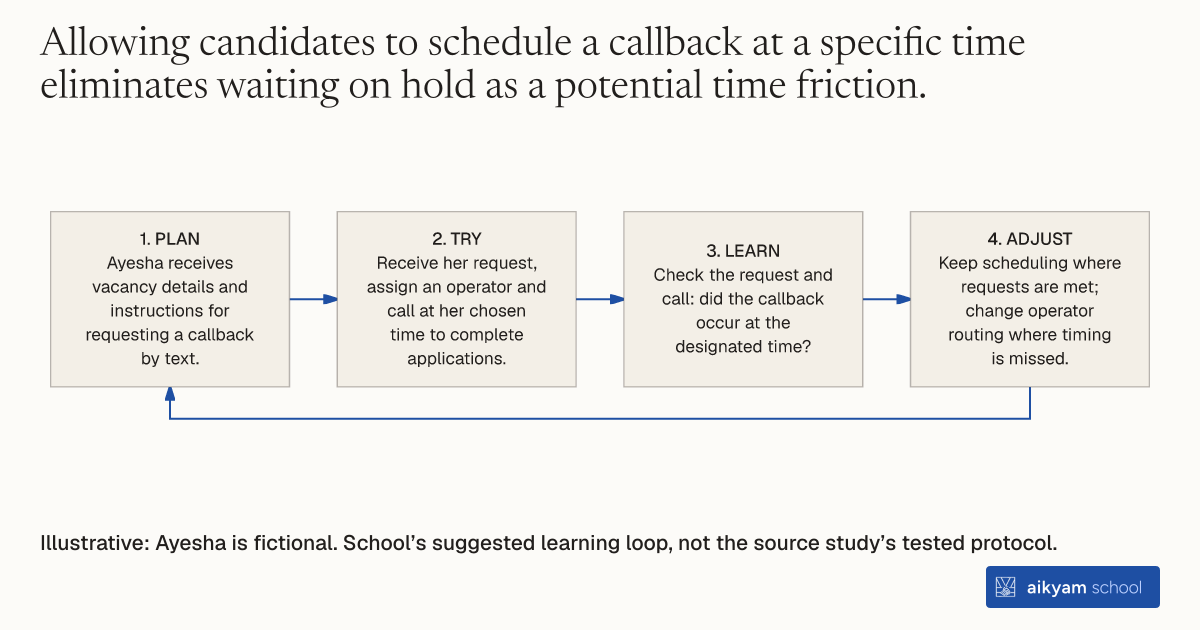
Try, learn and adjust
Check callbacks follow requested times
- Plan: Ayesha receives vacancy details and instructions for requesting a callback by text.
- Try: Receive her request, assign an operator and call at her chosen time to complete applications.
- Learn: Check the request and call: did the callback occur at the designated time?
- Adjust: Keep scheduling where requests are met; change operator routing where timing is missed.
Illustrative: Ayesha is fictional. School’s suggested learning loop, not the source study’s tested protocol.
See source →School’s suggested loop, not a tested source procedure. Observe requested times, callbacks and applications; do not assume scheduled calls equal proactive outreach.
How
When to use
Jobseekers may hesitate to call employment platforms if they anticipate waiting on hold or paying for phone time. Offering candidates the option to text the platform to request a callback at a specific time eliminates waiting time differentials. It is intended for employment services and helpline platforms evaluating whether application bottlenecks stem from time delays.
Provide jobseekers with an automated option to schedule a callback from call center staff at a specific time.
- Send candidates match notifications listing open vacancies and contact options via text message.
- Include instructions in the text message informing candidates that they can send a text message to request a callback at a chosen time.
- Receive incoming SMS callback requests on the platform server.
- Route scheduled callback requests to call center operators based on requested time slots.
- Place an outbound phone call to the candidate at the designated time to complete their job applications.
Why it works
It tests whether time delays prevent candidates from applying or if initiation costs drive the application deficit.
Example
On the Job Talash platform in Lahore, Pakistan, researchers offered 7,004 jobseekers across 54,135 matches the option to text and schedule a callback at a specific time across three experimental rounds. The treatment increased application rates by 0.059 percentage points, explaining only one-quarter of the main phone call outreach effect.
About the study
Participants
N = 7,004 jobseekers (54,135 jobseeker-vacancy matches) in Lahore, Pakistan.
Study Design
Randomized mechanism experiment comparing the scheduled callback request option against standard phone call treatment and control groups across 3 matching rounds.
Results
The callback request treatment increased application probability by 0.059 percentage points (effect = 0.00059, p = 0.002 relative to main phone call treatment effect of 0.226 percentage points), which is 1/4th the size of the main phone call initiation treatment.