Research screening
Select plants for monitoring
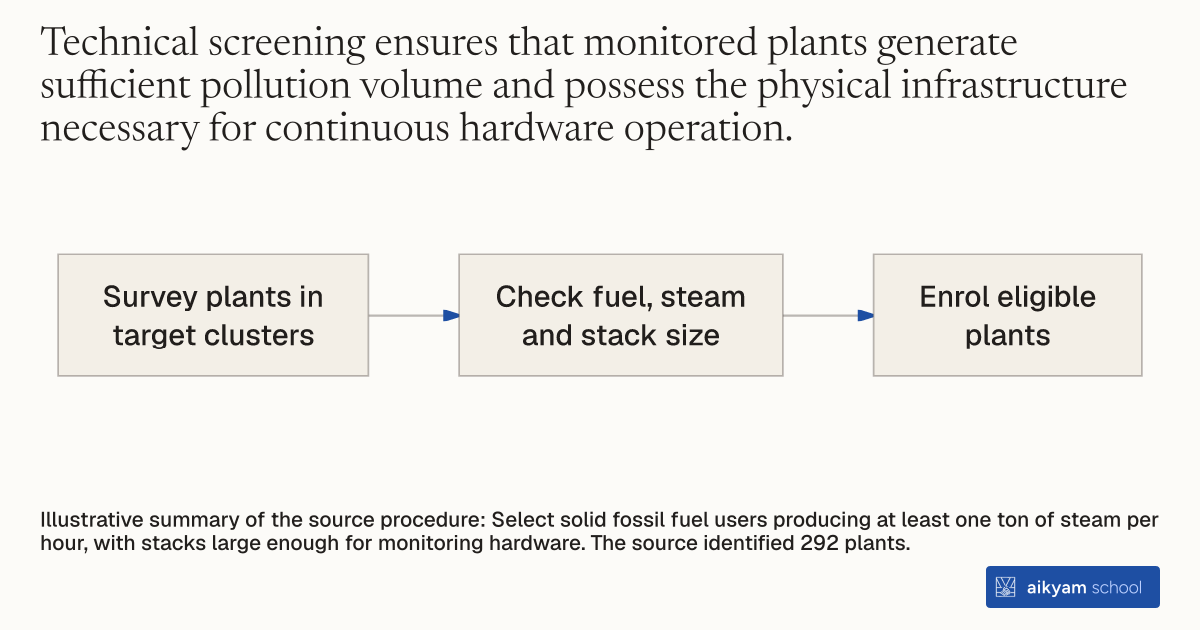
- Survey plants in target clusters
- Check fuel, steam and stack size
- Enrol eligible plants
Illustrative summary of the source procedure: Select solid fossil fuel users producing at least one ton of steam per hour, with stacks large enough for monitoring hardware. The source identified 292 plants.
See source →How
When to use
Regulators in polluted industrial regions must determine which factories are suitable for automated monitoring and market regulation. Standard environmental policies fail when applied uniformly without considering facility capacity for monitoring hardware. This method helps environmental authorities select viable small and medium manufacturing plants for continuous emissions oversight.
Screen industrial plants using fuel consumption, steam generation, and physical stack dimensions to build an eligible monitoring cohort.
- Survey industrial plants within targeted manufacturing clusters such as the textile industry in Surat.
- Select facilities that burn solid fossil fuels to power plant operations.
- Check that the plant produces a minimum of one ton of steam per hour.
- Measure chimney dimensions to ensure physical space for mounting Continuous Emissions Monitoring Systems hardware.
Example
The Gujarat Pollution Control Board screened industrial textile plants in Surat, India, identifying 292 facilities meeting fuel, steam, and chimney size requirements for continuous emissions monitoring.
About the study
Participants
292 small and medium industrial textile plants in Surat, Gujarat, India (156 assigned to market intervention, 136 to comparison group).
Study Design
Randomized Controlled Trial evaluating 292 eligible factories randomized into market trading or standard regulation across ten compliance cycles from September 2019 to April 2021.
Results
Applying these eligibility criteria established a sample of 292 factories that enabled full CEMS data collection, where market group plants reduced particulate matter emissions by 20 to 30 percent compared to command-and-control plants.