Research procedure
Build and verify a telephone voter list
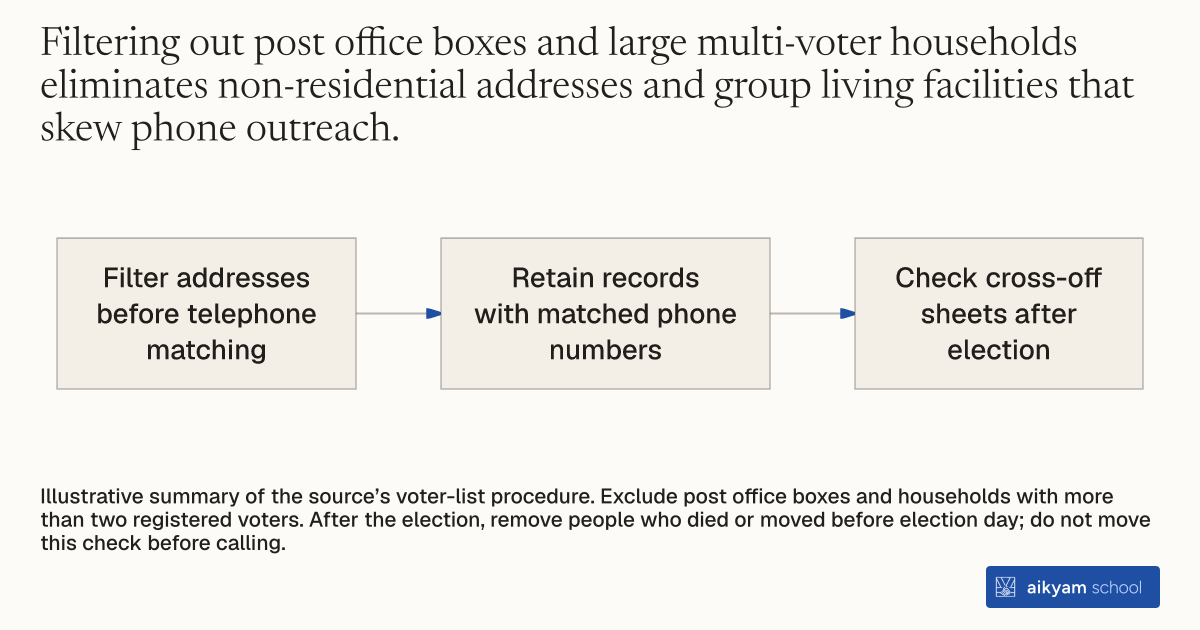
- Filter addresses before telephone matching
- Retain records with matched phone numbers
- Check cross-off sheets after election
Illustrative summary of the source’s voter-list procedure. Exclude post office boxes and households with more than two registered voters. After the election, remove people who died or moved before election day; do not move this check before calling.
See source →How
When to use
An organization needs to compile a target contact list of registered voters from public voter rolls for a campaign. Public voter records lack telephone numbers and contain invalid addresses that distort outreach targets. Filtering these records creates an accurate subject list matched with working phone numbers.
Compile a clean subject list from voter records by removing non-viable addresses and matching phone numbers.
- Obtain the complete list of registered voters and their household addresses from municipal public records.
- Group all voter records by household address.
- Exclude all voters residing at post office box addresses or in households with more than two registered voters.
- Send the remaining voter list to a commercial sampling vendor to locate landline telephone numbers.
- Retain all names and addresses that successfully match with telephone numbers.
- Match post-election voter cross-off sheets against the list and remove individuals who died or moved prior to election day.
Why it works
Matching public voter names to listed telephone numbers focuses campaign resources on reachable households with verifiable voting histories.
Example
Researchers in West Haven, Connecticut, obtained public voter rolls for all registered voters in the town of 54,000 residents prior to the 1998 general election. After filtering out post office boxes and households with more than two voters, they matched the list with a telemarketing database, obtaining phone numbers for about two-thirds of the records to form a final sample of 17,100 voters.
About the study
Participants
17,100 registered voters in West Haven, CT, a town of 54,000 residents during the 1998 general election.
Study Design
Public voter records were sorted by address, filtered to exclude post office boxes and households with over two voters, matched against telephone directories via Survey Sampling, Inc., and checked post-election against official voter cross-off sheets.
Results
Telephone numbers were located for approximately two-thirds of the names and addresses on the filtered registration list, yielding a verified sample of 17,100 voters across 6,843 control and 10,257 treatment subjects.