Research steps
Screen online responses before enrolment
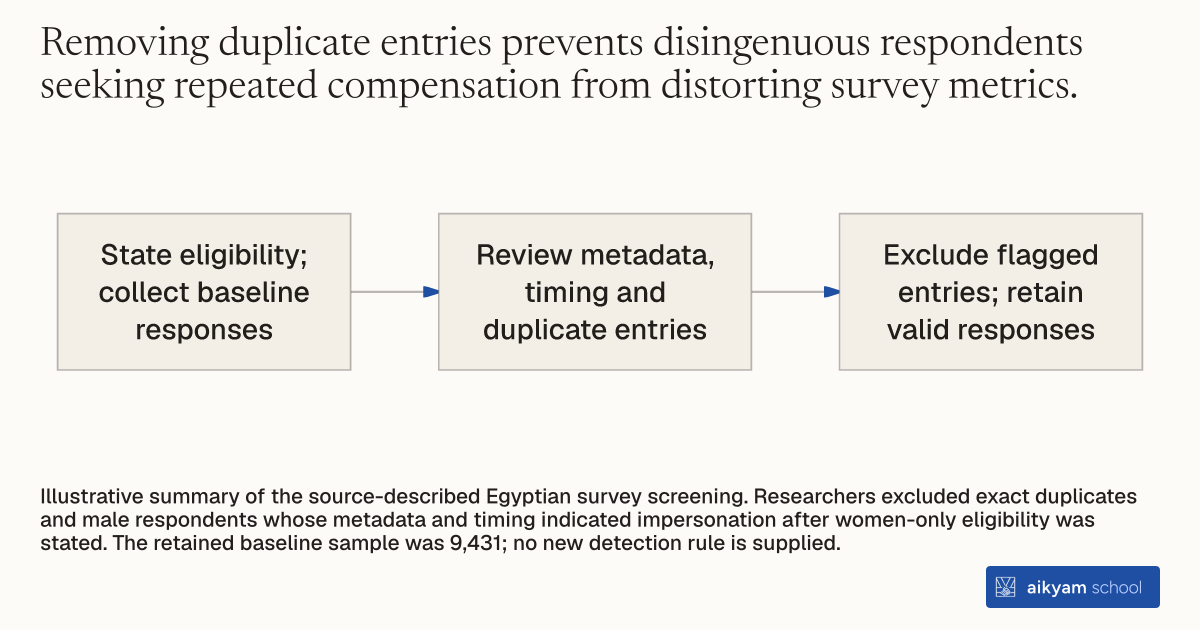
- State eligibility; collect baseline responses
- Review metadata, timing and duplicate entries
- Exclude flagged entries; retain valid responses
Illustrative summary of the source-described Egyptian survey screening. Researchers excluded exact duplicates and male respondents whose metadata and timing indicated impersonation after women-only eligibility was stated. The retained baseline sample was 9,431; no new detection rule is supplied.
See source →How
When to use
Online surveys open to the public often attract duplicate submissions from respondents seeking financial incentives or ineligible individuals attempting to impersonate target demographics. Filtering out invalid entries ensures data integrity in remote studies focusing on specific populations. This method protects sample quality when evaluating digital social interventions.
Screen online survey datasets to identify and exclude duplicate submissions and ineligible impersonators before sample enrollment.
- Administer a web-based baseline survey to recruited online respondents.
- Inform respondents of specific demographic eligibility requirements, such as restricting participation strictly to women.
- Analyze survey platform backend metadata, IP addresses, and submission timestamps across raw responses.
- Flag and remove exact duplicate survey completions submitted by the same respondent.
- Identify male respondents whose metadata or rapid response timing indicates impersonation of female participants.
- Exclude all flagged responses to compile the final dataset of valid participants.
Why it works
Filtering out ineligible impersonators maintains demographic targeting when researching gender-specific social issues.
Example
In Egypt, researchers screened baseline online survey submissions collected via Qualtrics, removing exact duplicate entries and male respondents whose metadata indicated impersonation to yield 9,431 valid responses from Egyptian women.
About the study
Participants
9,431 valid female baseline respondents in Egypt retained after screening raw survey submissions.
Study Design
Data cleaning protocol embedded within an online RCT evaluating Qualtrics survey submissions collected through targeted Facebook advertisements.
Results
Screening raw baseline submissions successfully removed duplicate entries and male impersonators, leaving 9,431 valid responses, of whom 5,618 opted into the experimental trial.