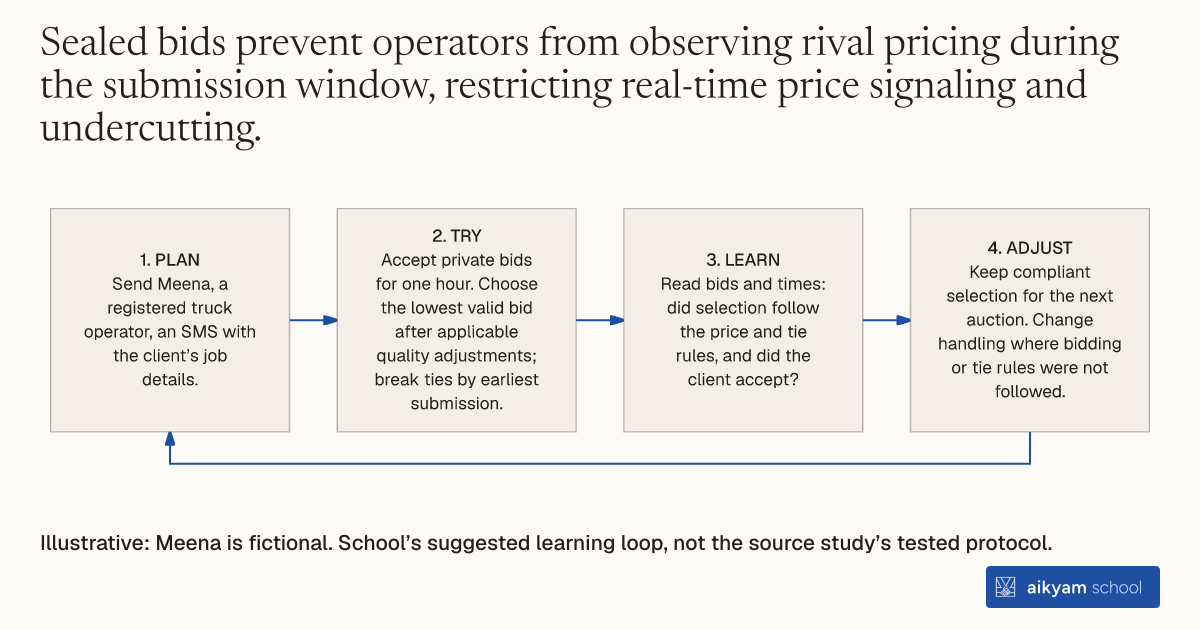
Try, learn and adjust
Check sealed bids follow auction rules
- Plan: Send Meena, a registered truck operator, an SMS with the client’s job details.
- Try: Accept private bids for one hour. Choose the lowest valid bid after applicable quality adjustments; break ties by earliest submission.
- Learn: Read bids and times: did selection follow the price and tie rules, and did the client accept?
- Adjust: Keep compliant selection for the next auction. Change handling where bidding or tie rules were not followed.
Illustrative: Meena is fictional. School’s suggested learning loop, not the source study’s tested protocol.
See source →School’s suggested, untested loop. Observe private submissions, the one-hour window, tie timestamps and client acceptance before releasing contact details.
How
When to use
Municipal sanitation platforms need to source mechanized desludging services for individual residential households without disclosing rival price offers during bidding. The method prevents real-time price coordination and bidding signaling among competing service providers in local utility markets. It is designed for procurement managers and market designers seeking to solicit private price offers from informal transport operators.
Solicit private, unobservable price offers from a panel of service providers via short message service within a bounded submission window.
- Call center dispatchers send an SMS invitation containing client location and pit details to a randomly selected panel of registered truck operators.
- Invited operators evaluate job details and determine their private bid amount without observing rival submissions.
- Operators submit a single text message bid to the platform within a strict one-hour submission window.
- Dispatchers log incoming bids, adjust for past service quality penalties if applicable, and select the lowest valid bid.
- In the event of identical lowest bids, dispatchers break ties by awarding the contract to the operator who submitted the winning price earliest.
- Dispatchers present the lowest price offer to the client and send client contact details to the winner upon client acceptance.
Why it works
Bidders retain an incentive to submit bids early because the platform resolves ties in favor of the earliest timestamp at the winning price.
Example
The call center in Dakar, Senegal conducted sealed-bid SMS auctions for household desludging jobs, inviting between 5 and 21 vacuum truck operators per auction. Bidders had one hour to respond, with 23.6% of multi-bid sealed auctions ending in exact ties due to heavy bidder reliance on 5,000 CFA focal price increments.
About the study
Participants
1,807 sealed-bid auctions conducted across 126 registered vacuum truck operators in peri-urban residential neighborhoods of Dakar, Senegal (out of 3,627 total valid auctions in the sample).
Study Design
Randomized field experiment comparing sealed-bid SMS auctions (one-hour window, no intermediate price updates, ties awarded to earliest timestamp) with revisable-bid auctions.
Results
Sealed-bid auctions resulted in a 23.6% tie rate (9.3 percentage points higher than revisable-bid auctions) and 57.3% of winning bids fell on 5,000 CFA round-number grid points, while winning bids arrived in the last ten minutes in only 13.8% of sealed-bid auctions compared to 42.1% in revisable-bid auctions.