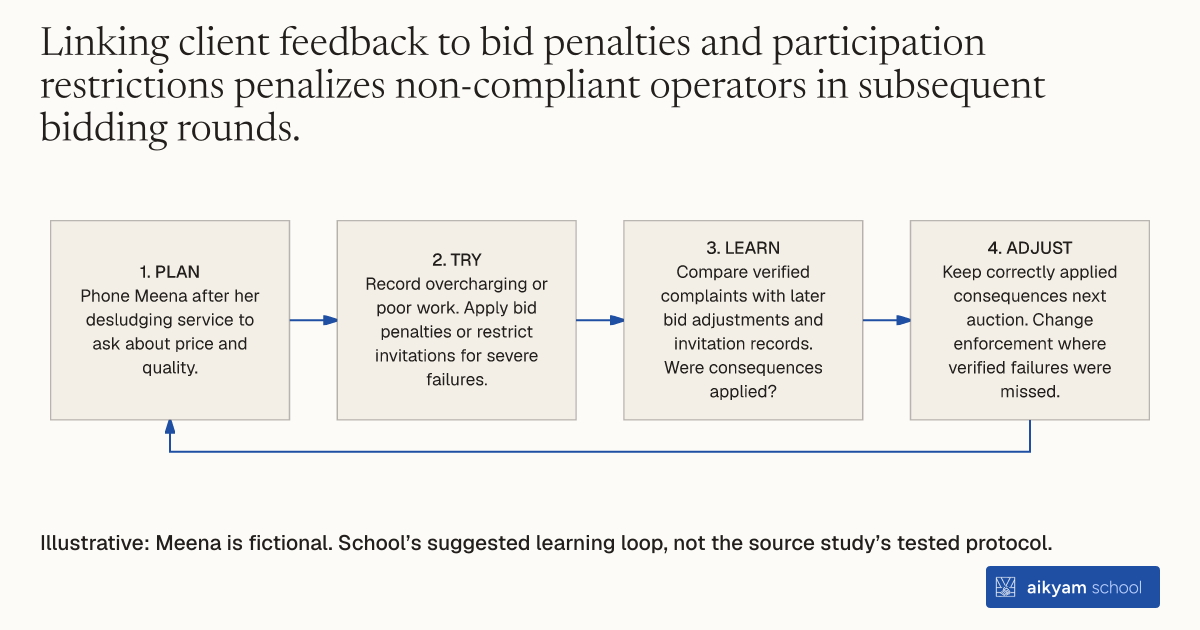
Try, learn and adjust
Use verified complaints in later auctions
- Plan: Phone Meena after her desludging service to ask about price and quality.
- Try: Record overcharging or poor work. Apply bid penalties or restrict invitations for severe failures.
- Learn: Compare verified complaints with later bid adjustments and invitation records. Were consequences applied?
- Adjust: Keep correctly applied consequences next auction. Change enforcement where verified failures were missed.
Illustrative: Meena is fictional. School’s suggested learning loop, not the source study’s tested protocol.
See source →School’s suggested, untested loop. Observe complaints, bid adjustments and invitation restrictions. The source describes penalties in the initial phase, before their 2015 removal.
How
When to use
Public procurement managers need to prevent contractor overcharging and substandard performance in decentralized utility platforms. The method addresses post-award moral hazard and price gouging when service providers operate without direct physical supervision. It is designed for program administrators enforcing contract compliance across informal service sectors.
Deter contract violations by penalizing offending service providers in subsequent auction bids or restricting their future platform participation.
- Call center operators survey clients by phone after job completion to check for overcharging or poor service.
- Platform staff record client complaints regarding unfinished work, environmental spills, or bids exceeded at payment.
- System administrators apply monetary penalty adjustments to the future bids submitted by non-compliant providers.
- System administrators restrict providers with severe quality infractions from receiving future auction invitations.
- Platform operators notify providers that recorded service penalties directly reduce their future winning chances.
Why it works
Knowing that poor performance or price gouging reduces future contract wins incentivizes winning providers to deliver quality work at agreed prices.
Example
In the initial phase of the Dakar desludging auction platform, call center staff conducted follow-up client surveys and applied bid penalties or future auction restrictions to truck operators who charged more than agreed prices or delivered low quality service.
About the study
Participants
126 registered vacuum truck operators invited across 5,331 total auctions (including 2,825 auctions conducted during the initial phase with quality penalties) in Dakar, Senegal.
Study Design
Randomized field trial oversight mechanism incorporating quality penalties into the auction winning-bid evaluation formula during the first platform phase (mid-2013 to late-2014).
Results
Post-service phone auditing and penalty enforcement helped maintain quality standards across platform jobs, where winning bids were evaluated net of accumulated penalty points before penalties were phased out in 2015 when all truckers received equal invitation weights.