Try, learn and adjust
Check withdrawal requests before summer rates restart
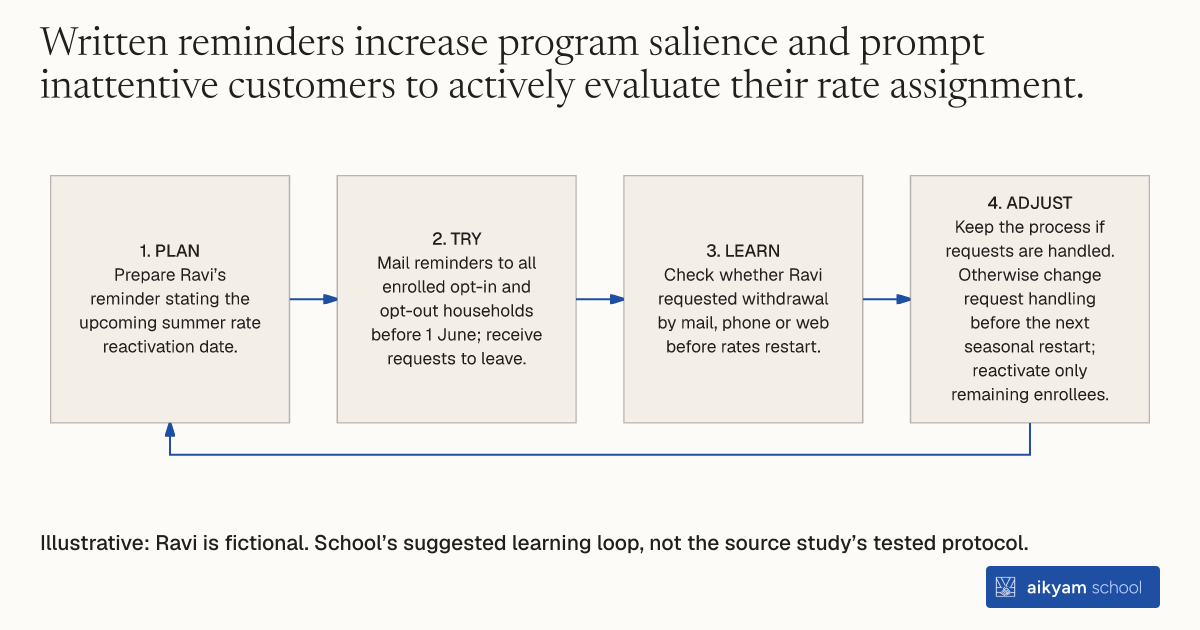
- Plan: Prepare Ravi’s reminder stating the upcoming summer rate reactivation date.
- Try: Mail reminders to all enrolled opt-in and opt-out households before 1 June; receive requests to leave.
- Learn: Check whether Ravi requested withdrawal by mail, phone or web before rates restart.
- Adjust: Keep the process if requests are handled. Otherwise change request handling before the next seasonal restart; reactivate only remaining enrollees.
Illustrative: Ravi is fictional. School’s suggested learning loop, not the source study’s tested protocol.
See source →Observe withdrawal requests and remaining enrolment before 1 June. Reminders can prompt customers to leave. School’s suggested learning loop; not a tested source procedure.
How
When to use
Public utilities face customer disenrollment or fading program awareness when seasonal pricing tariffs pause during winter and resume in summer. Sending a second-summer reminder letter re-engages enrolled customers and notifies them of upcoming rate reactivations. This intervention maintains program transparency while giving participants a clear opportunity to adjust their enrollment.
Send a written reminder letter to all enrolled participants prior to the start of a second seasonal pricing period.
- Prepare personalized reminder letters notifying participants of the upcoming summer rate reactivation date.
- Mail the reminder letters to all enrolled households across opt-in and opt-out pricing plans before June 1 of the second summer.
- Receive disenrollment requests via mail, phone, or web portal from customers who choose to leave the program.
- Reactivate time-varying tariff structures on June 1 for all remaining enrolled participants.
Why it works
While reminders trigger a modest wave of disenrollments, most defaulted households choose to remain in the program.
Example
SMUD mailed a second-summer reminder letter to active participants in Sacramento, California prior to June 1, 2013, which caused a small increase in drop-outs while maintaining overall program participation above 89 percent.
About the study
Participants
Mailed to active households among 6,435 enrolled study participants in Sacramento, California.
Study Design
Accelerated failure time Weibull hazard modeling evaluating disenrollment hazard rates following discrete operational events across two consecutive summer seasons.
Results
The second-summer reminder letter statistically significantly accelerated participant drop-out rates (AFT coefficient -4.252, p < 0.001), though total 16-month disenrollment remained under 7 percent of initial participants across all treatment groups.