Try, learn and adjust
Check funding and tax guidance supports applications
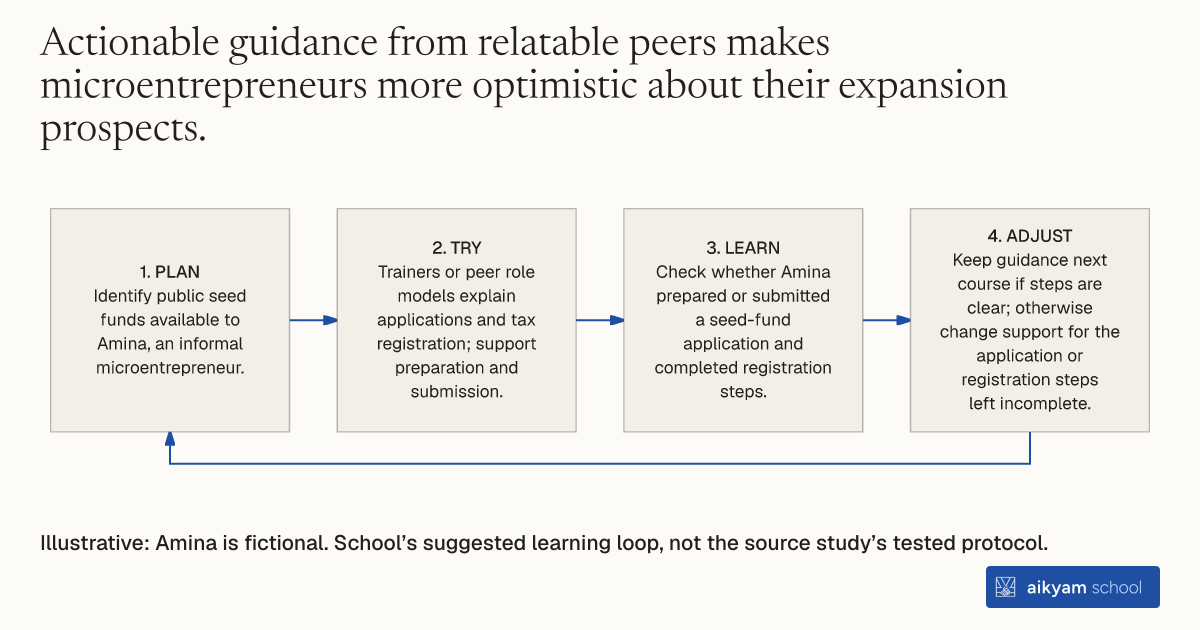
- Plan: Identify public seed funds available to Amina, an informal microentrepreneur.
- Try: Trainers or peer role models explain applications and tax registration; support preparation and submission.
- Learn: Check whether Amina prepared or submitted a seed-fund application and completed registration steps.
- Adjust: Keep guidance next course if steps are clear; otherwise change support for the application or registration steps left incomplete.
Illustrative: Amina is fictional. School’s suggested learning loop, not the source study’s tested protocol.
See source →School’s suggested, untested learning loop. Observe applications and formal registration, without assuming funding success or income gains.
How
When to use
Informal microentrepreneurs often face obstacles in growing their businesses because they lack guidance on applying for competitive funding and navigating formal legal requirements. Providing direct advice during training sessions helps business owners overcome bureaucratic hurdles and access financial support. This method serves informal microentrepreneurs seeking to formalize operations and secure growth capital.
Provide targeted advice within training sessions to help microentrepreneurs apply for public seed capital funds and formally register with tax authorities.
- Identify government and public seed capital grant programs available to informal small business owners.
- Integrate actionable application guidance into training course sessions, delivered by peer role models or trainers.
- Walk participants through the formal tax registration steps required by government revenue authorities.
- Explain how formal registration and capital acquisition enable business expansion and continuity.
- Support participants as they prepare and submit competitive seed fund application forms.
Why it works
This confidence encourages participants to take concrete steps toward applying for government funding and registering their businesses formally.
Example
In Chile, peer role models in training courses delivered by Simón de Cirene offered actionable advice on applying for seed funds and registering with tax authorities to 1,712 low-income microentrepreneurs, 92 percent of whom were women. One year after program start, participants who received this guidance were significantly more likely to apply for public seed funds and register formally with tax authorities, earning an average monthly household income of US$279 compared to US$228 in the comparison group.
About the study
Participants
1,712 participants in 66 training courses across Chile, 92 percent female, with all belonging to the lowest two income quartiles.
Study Design
A two-stage randomized evaluation measuring treatment effects of 34 courses assigned to receive role model visits providing seed capital and tax guidance versus 32 comparison courses, tracked via phone survey one year post-intervention.
Results
Participants receiving this guidance were significantly more likely to apply for seed funds or formally register with tax authorities, contributing to a US$30 to US$50 (about 15 percent) increase in monthly household income.