Try, learn and adjust
Check seed selection through women’s groups
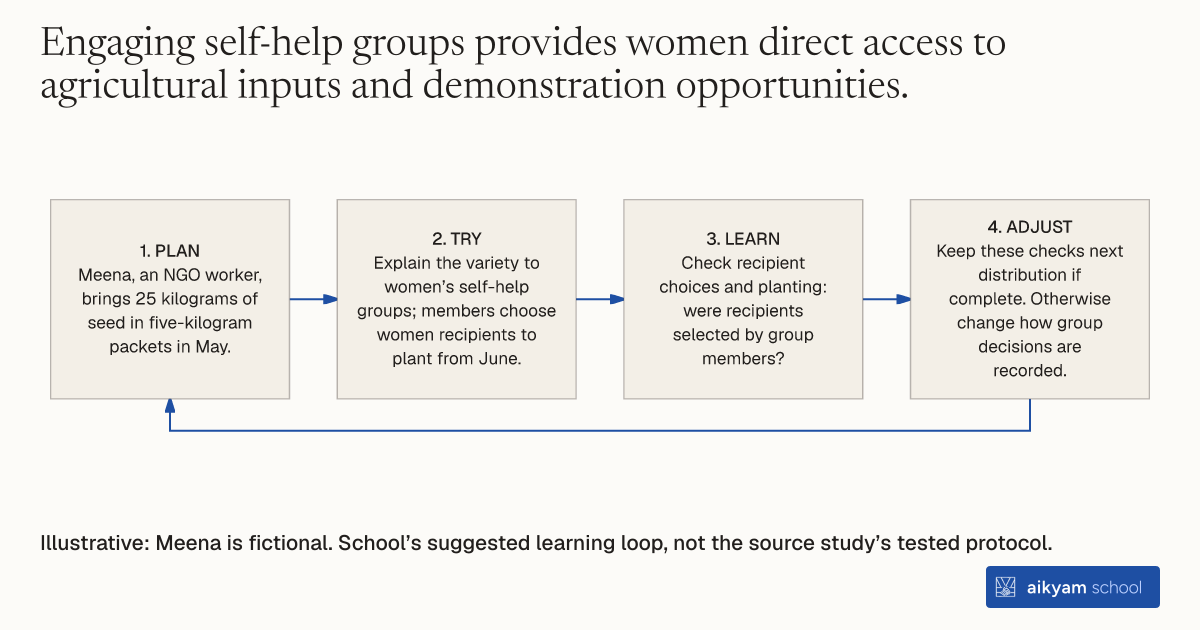
- Plan: Meena, an NGO worker, brings 25 kilograms of seed in five-kilogram packets in May.
- Try: Explain the variety to women’s self-help groups; members choose women recipients to plant from June.
- Learn: Check recipient choices and planting: were recipients selected by group members?
- Adjust: Keep these checks next distribution if complete. Otherwise change how group decisions are recorded.
Illustrative: Meena is fictional. School’s suggested learning loop, not the source study’s tested protocol.
See source →School’s suggested, untested learning loop. Observe women’s group selection and planting; this loop does not establish later peer adoption effects.
How
When to use
Smallholder farmers require flood-tolerant crop varieties, but traditional male-dominated or official distribution channels may exclude women. Program managers need a targeted channel to engage women's community groups as early technology demonstrators. This method distributes trial seed packages exclusively through women's self-help groups.
Distribute trial seed packages through women's self-help groups to engage female farmers as early technology demonstrators.
- NGO staff visit target villages in May carrying 25 kilograms of a new seed variety divided into five-kilogram packets.
- NGO staff invite members of existing women's self-help groups to a short meeting about a new flood-tolerant rice variety.
- NGO staff present the seed packets and describe the variety's performance benefits over traditional varieties.
- Self-help group members jointly decide which group members receive the seed packets to cultivate.
- Selected women farmers plant the seed packets during the wet season starting in June.
Why it works
Even though early adopters are chosen exclusively from women's groups, peer learning across the broader village remains just as effective as when chosen by village officials or general meetings.
Example
In 33 flood-prone villages in Odisha, India, NGO staff held meetings with women's self-help groups in May 2014 to present five-kilogram packets of flood-tolerant Swarna-Sub1 rice seed. Group members selected recipients who cultivated the seeds during the wet season. Downstream seed adoption in these villages reached levels identical to villages where early adopters were selected by elected officials or open village meetings.
About the study
Participants
33 villages in Odisha, India; rice farmers where two-thirds lived below the US$2.15/day poverty line and one-third belonged to scheduled castes.
Study Design
Randomized evaluation where 33 out of 100 villages were assigned to seed distribution through women's self-help groups.
Results
Selecting early adopters exclusively through women's self-help groups resulted in downstream peer seed adoption rates identical to those in villages using elected officials or general village meetings.