Research groups
Randomise selected public radio stations
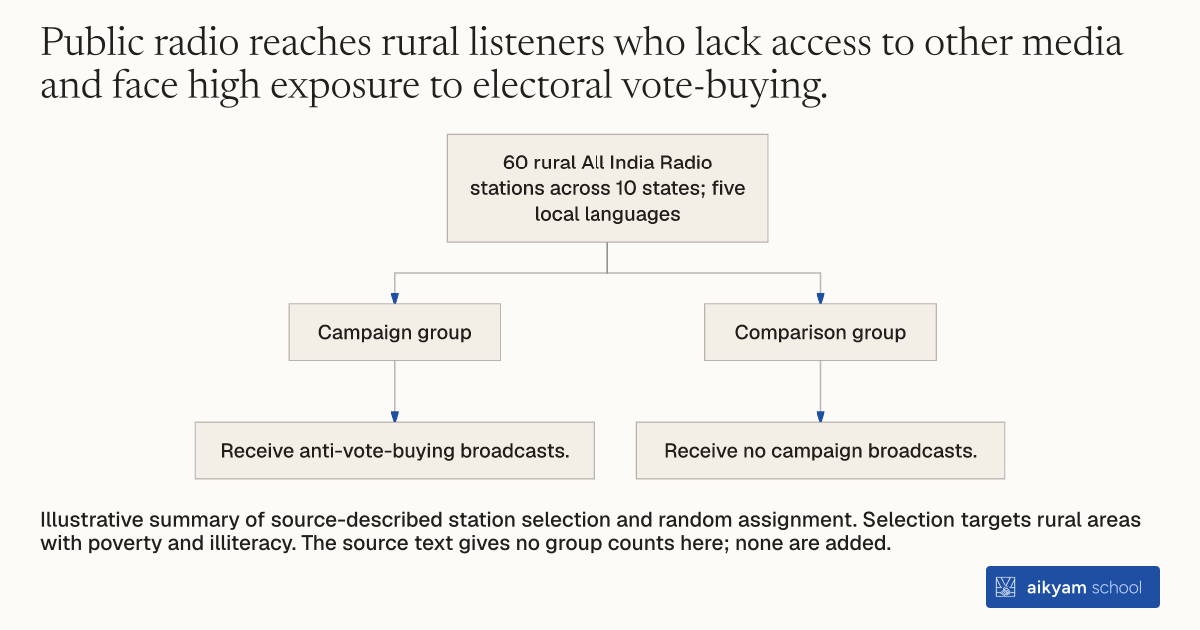
60 rural All India Radio stations across 10 states; five local languages
- Campaign group
- Receive anti-vote-buying broadcasts.
- Comparison group
- Receive no campaign broadcasts.
Illustrative summary of source-described station selection and random assignment. Selection targets rural areas with poverty and illiteracy. The source text gives no group counts here; none are added.
See source →How
When to use
Media interventions aiming to reach broad, vulnerable populations must select channels with maximum rural coverage. Public radio networks serve rural communities facing high rates of poverty and illiteracy. Organizers randomize regional station coverage areas to evaluate broadcast impacts across large democratic populations.
Select and randomize regional public radio stations serving rural, low-income listener populations to deliver targeted media interventions.
- Evaluators identify public radio stations from the national broadcaster network covering target election regions.
- Filter stations to select those serving rural areas with high rates of poverty and illiteracy.
- Restrict selection to stations broadcasting in primary local languages spoken by major listener populations.
- Randomly assign selected stations into a treatment campaign group and an unexposed comparison group.
Why it works
Randomizing station assignment creates comparable treatment and control listener populations across diverse geographic regions.
Example
Researchers selected 60 All India Radio stations serving rural areas in five local languages across 10 states and randomly assigned them into campaign and comparison groups.
About the study
Participants
60 of All India Radio's 194 stations across 10 Indian states, covering 67 percent of the country's population and 62 percent of parliamentary constituencies.
Study Design
Clustered randomized experiment assigning 60 rural All India Radio stations to treatment or control groups.
Results
Randomization successfully established comparable groups across 60 station coverage areas, enabling precise evaluation of campaign impacts.