Research media survey
Check reported radio coverage
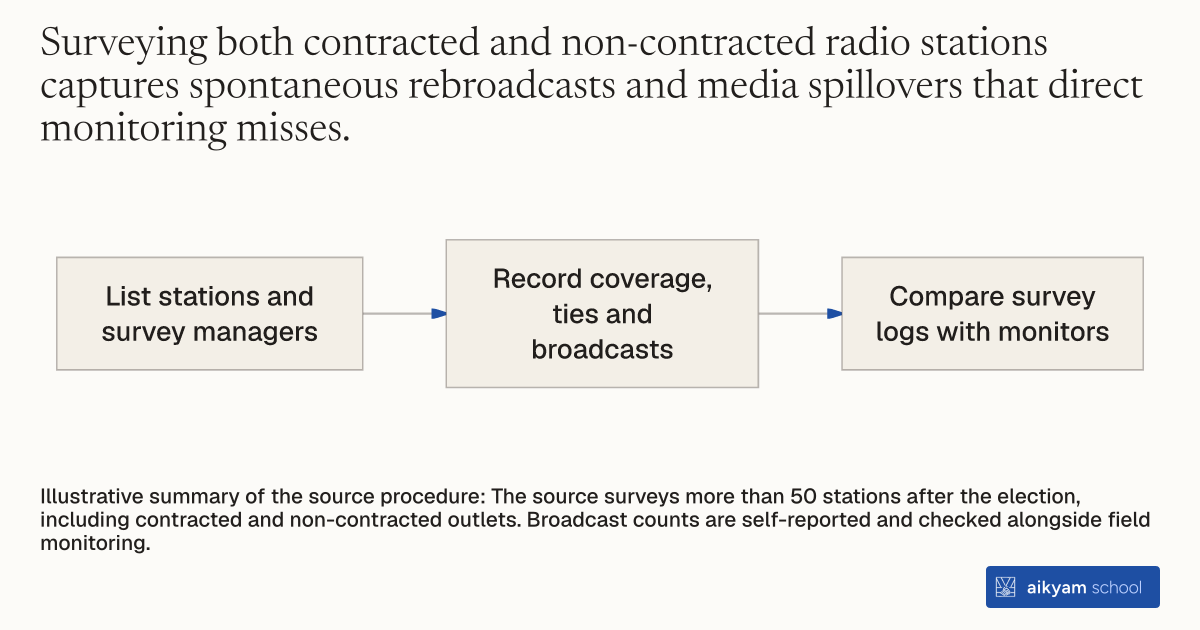
- List stations and survey managers
- Record coverage, ties and broadcasts
- Compare survey logs with monitors
Illustrative summary of the source procedure: The source surveys more than 50 stations after the election, including contracted and non-contracted outlets. Broadcast counts are self-reported and checked alongside field monitoring.
See source →How
When to use
When evaluating mass media campaigns, evaluators cannot assume contracted partner stations are the only outlets airing political programming or that non-partner stations remain silent. Unmonitored broadcasts across local networks can create experimental spillovers and obscure true citizen exposure. This method surveys radio station managers to measure signal coverage, political affiliations, and total broadcast frequency.
Survey regional radio station executives to assess signal reach, station ownership, and total debate rebroadcasts across targeted districts.
- Research team members compile a registry of all active community and commercial radio stations operating across the electoral districts.
- Enumerators administer a post-election survey to station managers across more than 50 radio stations.
- Enumerators record station operational characteristics, including signal strength, population coverage, and station ownership or candidate affiliations.
- Surveyors document the total number of times each station rebroadcast district candidate debates, including both contracted and uncontracted airings.
- Evaluators analyze self-reported broadcast logs alongside field monitor data to estimate total media coverage and confirm broadcast implementation across treatment arms.
Why it works
Identifying station ownership and signal range allows researchers to adjust for media fragmentation and candidate political ties.
Example
Researchers surveyed over 50 radio stations across Liberia following the October 2017 legislative elections. The survey showed that stations rebroadcast district candidate debates an average of 7.47 times in control districts and 7.70 times in treated districts, verifying widespread debate dissemination.
About the study
Participants
More than 50 radio stations across all 73 electoral districts in Liberia following the October 2017 election.
Study Design
Post-election media survey administered to radio station managers across treatment and control districts to assess station characteristics, political ties, and debate rebroadcast frequency.
Results
Radio stations reported an average of 7.47 total debate rebroadcasts in control districts and 7.70 in treated districts (estimated treatment difference of 1.055 broadcasts unweighted and 0.326 weighted), confirming high overall broadcast dissemination.