Research steps
Weight networks by message meaning
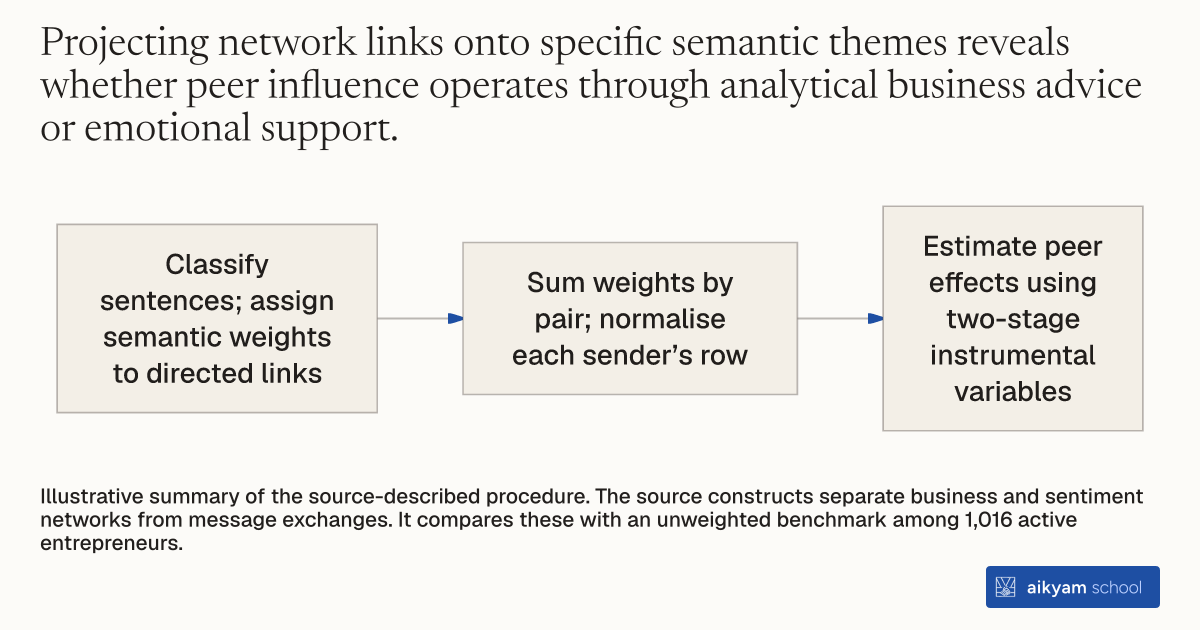
- Classify sentences; assign semantic weights to directed links
- Sum weights by pair; normalise each sender’s row
- Estimate peer effects using two-stage instrumental variables
Illustrative summary of the source-described procedure. The source constructs separate business and sentiment networks from message exchanges. It compares these with an unweighted benchmark among 1,016 active entrepreneurs.
See source →How
When to use
Researchers need to evaluate whether specific categories of peer communication drive network peer effects differently than overall message volume. Standard unweighted social networks count all message interactions equally regardless of topic. Constructing semantically weighted networks projects interaction ties onto distinct thematic dimensions such as business focus or sentiment.
Construct semantically weighted social networks by filtering bilateral message exchanges through natural language processing categories.
- Classify all platform messages sent between participants into semantic categories including business relevance and sentiment using trained machine learning models.
- Assign the predicted semantic probability weight of each sentence to the corresponding directed link between the sender and receiver.
- Sum the category-specific sentence weights across all messages exchanged between each pair of entrepreneurs to form raw directional interaction matrices.
- Normalize row totals of the raw semantic interaction matrices to derive row-stochastic adjacency matrices for business and sentiment networks.
- Estimate network peer effects on entrepreneurial submission and quality outcomes using two-stage instrumental variable regressions on the semantically projected adjacency matrices.
Why it works
Although individual messages are polarized between business and sentiment, entrepreneurs maintain a balanced mix of both content types in their bilateral interactions with peers.
Example
Data scientists constructed business-weighted and sentiment-weighted networks for 1016 active entrepreneurs across virtual treatment arms in 44 African nations. Both semantically projected networks produced peer effect estimates nearly identical to the unweighted benchmark network across submission and proposal quality outcomes.
About the study
Participants
1016 active entrepreneurs who completed Milestone 0 on time across 44 interaction clusters in virtual treatment arms.
Study Design
Two-stage Instrumental Variable OLS regression comparing unweighted benchmark networks, business-weighted networks, and sentiment-weighted networks using second-neighbor baseline characteristics as instruments.
Results
Bilateral interaction flows in the business-weighted and sentiment-weighted networks correlated strongly with the benchmark network (\\(r = 0.821\\) and \\(r = 0.951\\), respectively). In large-country virtual-within groups, peer effects on submission were virtually identical across benchmark (\\(\beta = 0.533, p < 0.01\\)), business-weighted (\\(\beta = 0.521, p < 0.01\\)), and sentiment-weighted (\\(\beta = 0.530, p < 0.01\\)) networks.