Research procedure
Test communication lag thresholds
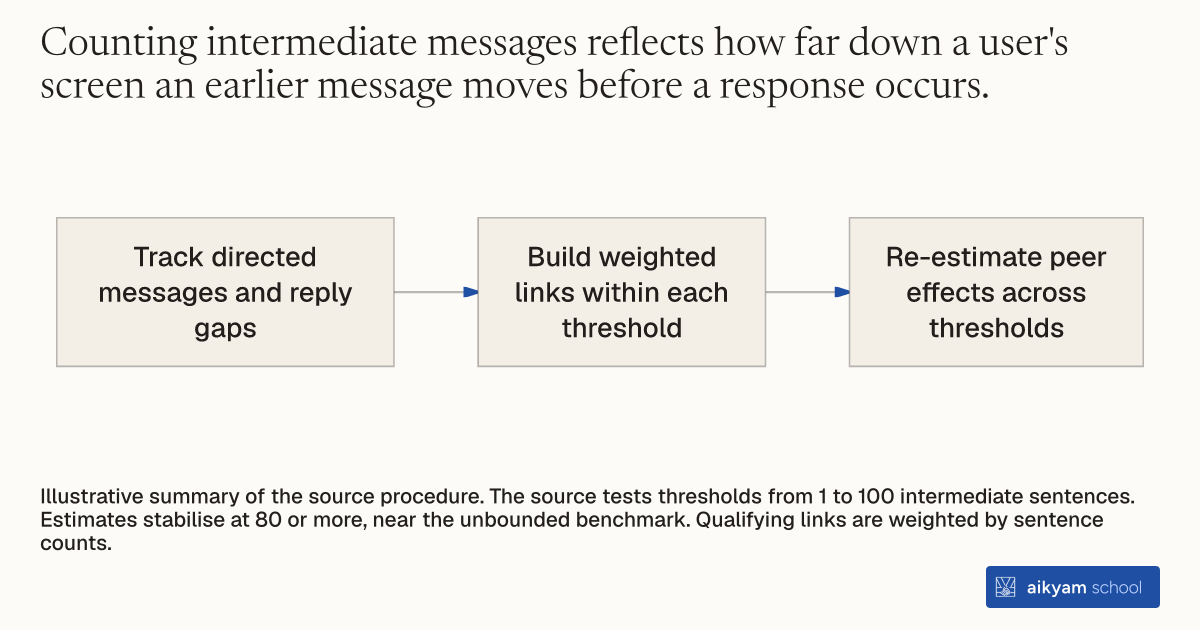
- Track directed messages and reply gaps
- Build weighted links within each threshold
- Re-estimate peer effects across thresholds
Illustrative summary of the source procedure. The source tests thresholds from 1 to 100 intermediate sentences. Estimates stabilise at 80 or more, near the unbounded benchmark. Qualifying links are weighted by sentence counts.
See source →How
When to use
Researchers need to define communication links between participants in online platforms without assuming infinite attention spans. Counting message replies separated by long gaps can introduce noisy or irrelevant network connections. Restricting link formation to a maximum communication lag ensures that network ties capture active peer interaction.
Parametrize communication link creation in digital chat platforms using an upper bound on intermediate messages.
- Track all directed messages sent between participants across online discussion channels.
- Count the number of intermediate messages posted in a channel between an initial message and a subsequent peer response.
- Establish a directed network link between two participants only if the intermediate message count is below a maximum threshold parameter \tau.
- Calculate link weights by summing total sentence counts across qualifying message pairs.
- Estimate network peer effects across varying parameter values of \tau to determine the threshold where coefficient estimates stabilize.
Why it works
Setting a finite lag threshold removes distant or unrelated posts while retaining true conversational feedback.
Example
Researchers evaluated peer network links among 1016 active entrepreneurs across virtual treatment arms in 44 African nations. Testing communication lag thresholds from \tau = 1 to \tau = 100 intermediate sentences revealed that network peer effect estimates stabilize at \tau \ge 80, matching results from an unbounded benchmark network.
About the study
Participants
1016 active entrepreneurs who completed Milestone 0 on time across 44 interaction clusters in virtual treatment arms.
Study Design
Parametric evaluation of two-stage instrumental variable regressions across communication lag thresholds ranging from \tau = 1 to \tau = 100 intermediate sentences.
Results
Network peer effect estimates for proposal submission, extensive quality, and intensive quality stabilize when the communication lag threshold reaches \tau \ge 80, yielding coefficients virtually identical to the unbounded benchmark network (\beta = 0.533, p < 0.01 for submission; \beta = 0.327, p < 0.05 for extensive quality; \beta = 0.476, p < 0.01 for small-country intensive quality).