Research design
Keep delivery and survey teams separate
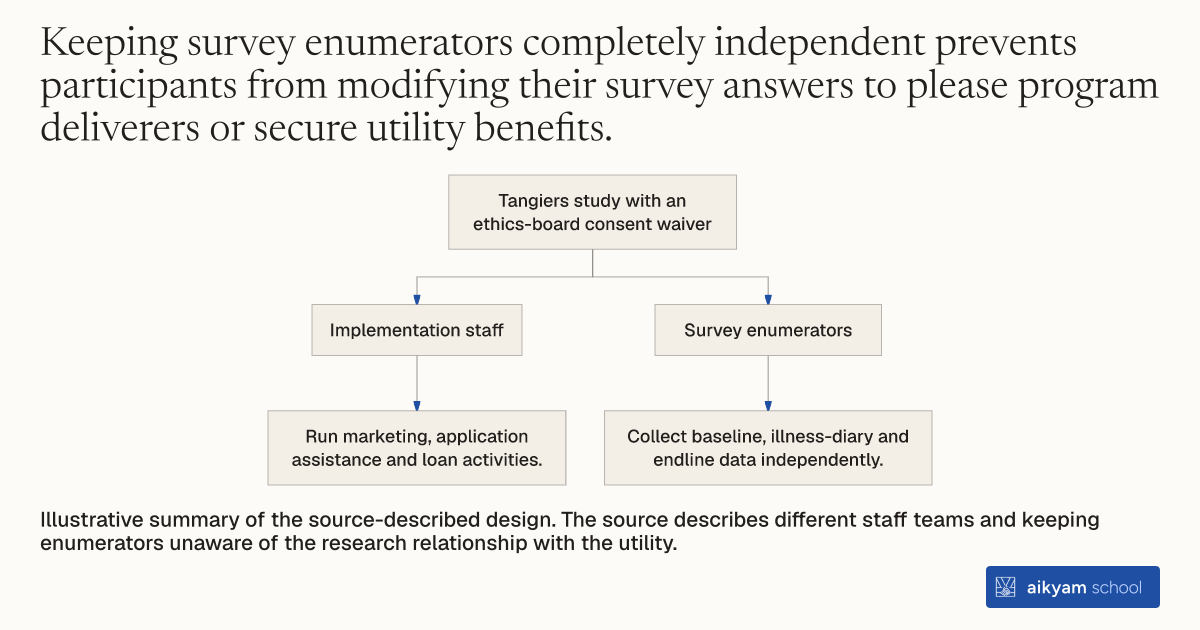
Tangiers study with an ethics-board consent waiver
- Implementation staff
- Run marketing, application assistance and loan activities.
- Survey enumerators
- Collect baseline, illness-diary and endline data independently.
Illustrative summary of the source-described design. The source describes different staff teams and keeping enumerators unaware of the research relationship with the utility.
See source →How
When to use
Field evaluations of social programs risk desirability bias if participants associate survey enumerators with program administrators. This method separates campaign delivery staff from data collection enumerators to ensure unbiased survey responses. It prevents respondents from exaggerating satisfaction or health outcomes to please implementation workers.
Separate program delivery staff from survey enumerators and maintain survey team double-blindness during field evaluations.
- Hire distinct teams of field workers, assigning one team exclusively to program implementation and another exclusively to survey administration.
- Restrict survey enumerators from participating in marketing, administrative facilitation, or loan collection activities.
- Keep the survey enumerator team uninformed regarding the research team's direct relationship with the program implementation partner.
- Obtain Institutional Review Board waivers of informed consent to defer revealing the full study design to participants until study completion.
- Direct independent enumerator teams to collect baseline, illness diary, and endline survey data across treatment and comparison groups.
Why it works
Blinding enumerators to the research team's program role prevents subtle enumerator probing or reporting bias during interviews.
Example
In Tangiers, Morocco, researchers completely separated the BSI credit marketing staff from the survey enumerators interviewing 845 baseline households. Maintainers obtained an IRB consent waiver so survey enumerators remained blind to the research team's relationship with the utility company Amendis, ensuring unbiased responses across endline surveys and health diaries.
About the study
Participants
845 low-income households (793 resurveyed at endline) across treatment and control groups in Tangiers, Morocco.
Study Design
Operational separation of implementation staff from survey teams combined with an IRB deferred consent waiver to preserve double-blind data collection.
Results
Operational separation eliminated desirability bias across 793 endline surveys, enabling objective measurement showing zero health effects despite high reported life satisfaction.