Research procedure
Collect private post-election vote reports
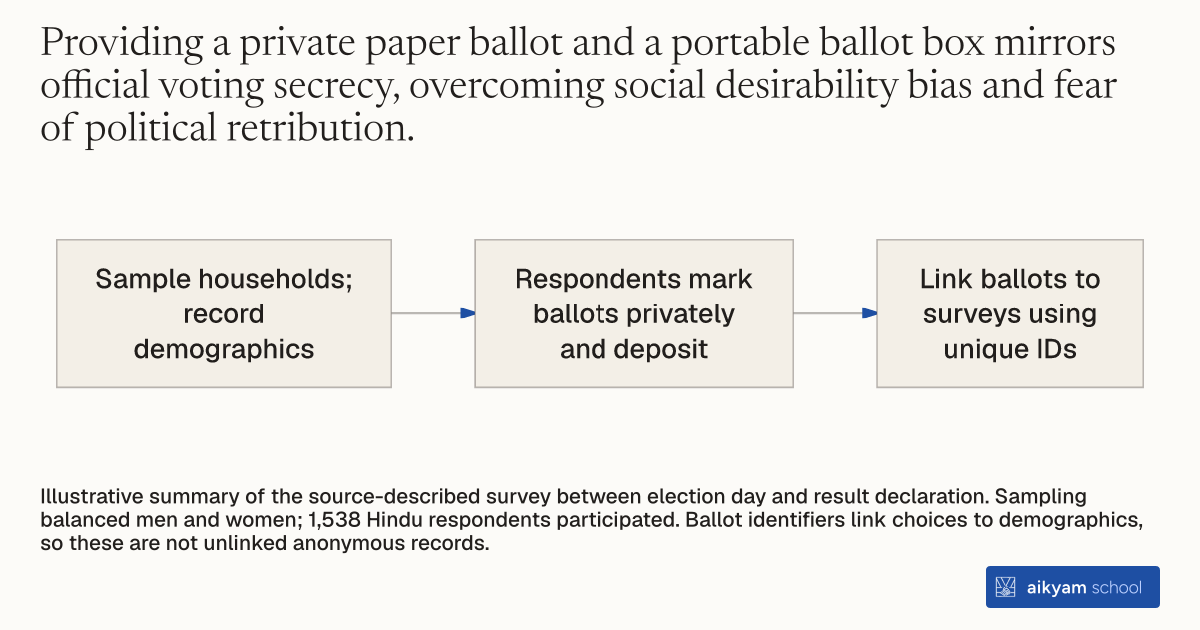
- Sample households; record demographics
- Respondents mark ballots privately and deposit
- Link ballots to surveys using unique IDs
Illustrative summary of the source-described survey between election day and result declaration. Sampling balanced men and women; 1,538 Hindu respondents participated. Ballot identifiers link choices to demographics, so these are not unlinked anonymous records.
See source →How
When to use
In political economy field experiments, individual voter choices in official elections are strictly anonymous, preventing researchers from measuring individual shifts in candidate preferences. A private secret-ballot post-election survey solves this by allowing respondents to mark a paper ballot sheet and place it into a portable ballot box during a household survey. This provides researchers with uncoerced individual vote choices linked directly to respondent demographic data.
Conduct a post-election household survey using a portable ballot box and paper ballot sheets to measure individual vote choices privately.
- Deploy survey enumerators to sample households in treated and control villages during the week between election day and the declaration of results.
- Stratify household sampling by gender to survey an equal number of male and female respondents per village.
- Record respondent demographic and socioeconomic characteristics, including age, gender, education, caste, income, and occupation.
- Hand the respondent a physical ballot sheet containing party choices and provide a portable ballot box.
- Instruct the respondent to mark their voting choice on the sheet privately and drop it into the ballot box.
- Link the respondent's demographic survey data to their private voting choice using a unique ballot sheet identifier.
Why it works
Linking unique ballot identifiers to demographic surveys allows researchers to analyze how individual characteristics shape vote choices while preserving perceived anonymity.
Example
A polling organization administered the private secret-ballot survey to 1,538 Hindu respondents across central Uttar Pradesh between election day and results declaration during the 2007 state assembly election. Survey predictions for major parties matched actual election results within 3 percentage points, matching BSP at 40% versus 43% actual, SP at 28% versus 30% actual, BJP at 11% versus 12% actual, and INC at 7% versus 5% actual.
About the study
Participants
The survey sampled 1,538 Hindu respondents (stratified by gender, including Scheduled Castes and Other Backward Castes) across 12 village units per cluster in Lalitpur, Bahraich, and Sitapur districts in Uttar Pradesh, India.
Study Design
Researchers integrated a private secret-ballot paper voting procedure into a post-election household survey conducted by CSDS between voting day and results announcement, linking individual socioeconomic variables to ballot choices via unique sheet IDs.
Results
The private secret-ballot procedure yielded vote share estimates within 3 percentage points of official returns for all four major parties (BJP: 11% survey vs 12% actual; BSP: 40% survey vs 43% actual; INC: 7% survey vs 5% actual; SP: 28% survey vs 30% actual), while revealing that support for caste-preferred parties was 57.6% in control villages.