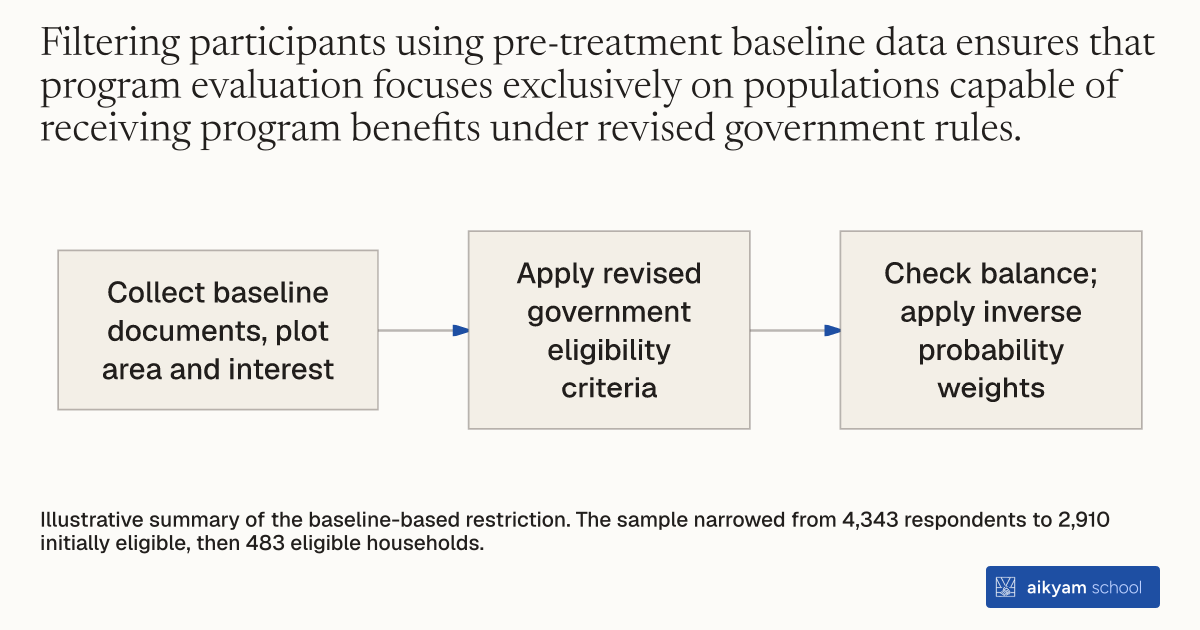
Research procedure
Restrict analysis to eligible households
- Collect baseline documents, plot area and interest
- Apply revised government eligibility criteria
- Check balance; apply inverse probability weights
Illustrative summary of the baseline-based restriction. The sample narrowed from 4,343 respondents to 2,910 initially eligible, then 483 eligible households.
See source →How
When to use
In social field experiments, government administrative rules and legal standards often shift during program execution. Researchers and program managers face changing policy constraints that render initial participant lists overly broad or legally invalid. Applying standardized baseline survey filters restricts analysis samples to participants who meet revised administrative criteria without compromising experimental balance.
Filter candidate populations using baseline survey data to restrict program samples to administratively eligible respondents.
- Administer pre-treatment baseline survey modules measuring household document ownership, plot built area, and interest in program participation as described in Section 4.2.
- Identify revised legal and administrative criteria established by government partners during program implementation.
- Filter baseline survey records to exclude households lacking original legacy land documents or necessary plot built areas.
- Verify that balance on observed baseline characteristics holds across treatment and control groups within the restricted sample.
- Re-weight sample observations using inverse probability weighting to adjust for potential attrition bias arising from sample restriction.
Why it works
This preserves randomized treatment balance while aligning evaluation samples with true administrative eligibility.
Example
Researchers in Kananga, DRC, filtered an initial sample of 2,910 respondents down to 483 eligible households using baseline survey data to match revised government land titling criteria.
About the study
Participants
4,343 survey respondents filtered down to 2,910 initially eligible respondents and ultimately 483 eligible households in Kananga, Democratic Republic of Congo.
Study Design
Pre-treatment baseline survey screening and sample restriction matching revised government administrative criteria within a randomized controlled trial.
Results
Restricting the sample to 483 eligible households maintained covariate balance across treatment arms and showed program assignment caused a 44 percentage point increase in titling initiation and a 13.7 percentage point increase in title receipt.