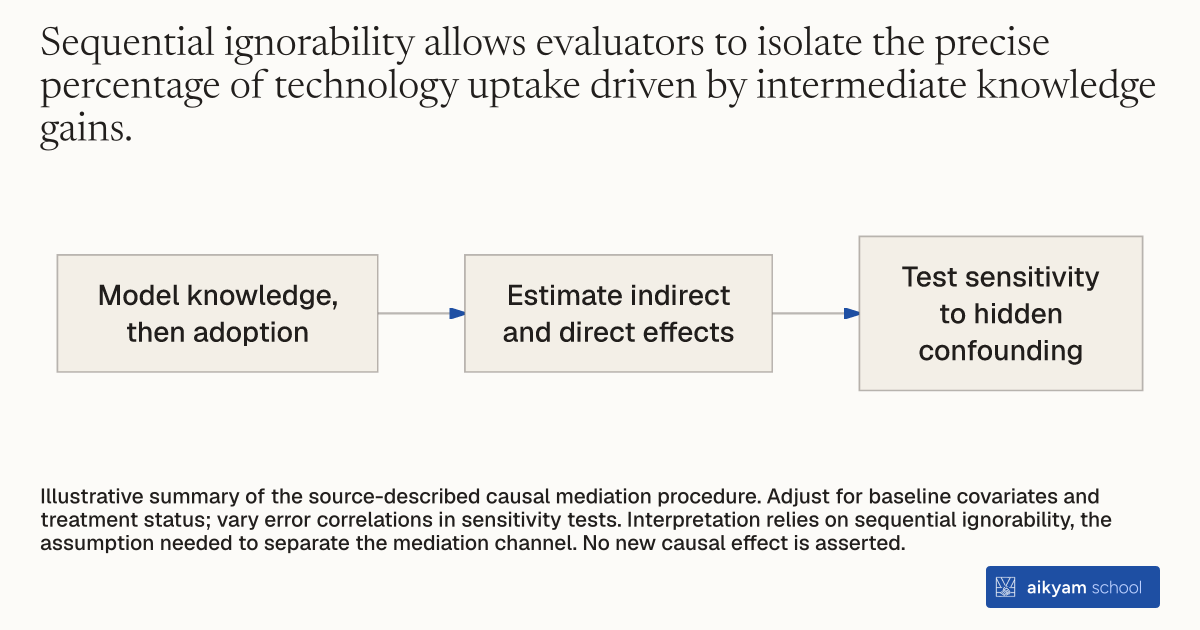
Research procedure
Separate knowledge-mediated and direct effects
- Model knowledge, then adoption
- Estimate indirect and direct effects
- Test sensitivity to hidden confounding
Illustrative summary of the source-described causal mediation procedure. Adjust for baseline covariates and treatment status; vary error correlations in sensitivity tests. Interpretation relies on sequential ignorability, the assumption needed to separate the mediation channel. No new causal effect is asserted.
See source →How
When to use
Evaluators of agricultural interventions need to isolate whether technology adoption stems directly from program activities or indirectly through specific cognitive knowledge gains. Standard regression models cannot separate direct treatment channels from indirect cognitive mechanisms. Causal mediation analysis decomposes total treatment effects into direct and mediated impacts while controlling for baseline confounders.
Decompose overall treatment effects into average causal mediation effects and average direct effects using sequential linear and probit regression equations.
- Estimate the effect of treatment assignment on mediating knowledge scores using baseline-adjusted linear regression.
- Estimate the effect of the knowledge mediator on technology adoption outcomes while controlling for treatment status and pre-treatment covariates.
- Calculate the average causal mediation effect as the product of the treatment-on-mediator and mediator-on-outcome regression coefficients.
- Estimate the average direct effect by holding the knowledge mediator constant while altering treatment status from control to treated.
- Perform sensitivity testing by varying error term correlation parameters to assess potential bias from unobserved confounders.
Why it works
Testing error term sensitivity ensures findings remain valid even if unobserved factors influence both knowledge acquisition and technology adoption.
Example
Researchers evaluated 2,334 rural farming household heads in Ethiopia to determine how knowledge gains mediated ISFM package adoption following extension and video interventions. Causal mediation estimates revealed that gains in how-to knowledge explained 16.1% to 23.0% of the extension treatment effect and 17.5% to 23.3% of the video treatment effect on technology adoption.
About the study
Participants
N = 2,334 rural household heads across 161 microwatersheds in Amhara, Oromia, and Tigray in Ethiopia.
Study Design
Causal mediation framework testing sequential ignorability across continuous mediators (how-to and principles knowledge scores) and binary/continuous adoption outcomes, supplemented by sensitivity parameter testing (\\(\rho \ne 0\\)).
Results
Gains in how-to knowledge accounted for 16.1% (p < 0.01) of T1 and 17.5% (p < 0.01) of T2 effects on adopted practice counts; principles knowledge explained 6.9% (p < 0.01) of T2 effects on practice counts and 6.4% (p < 0.01) of T2 effects on full-package adoption.