Try, learn and adjust
Check factory walkways stay clear
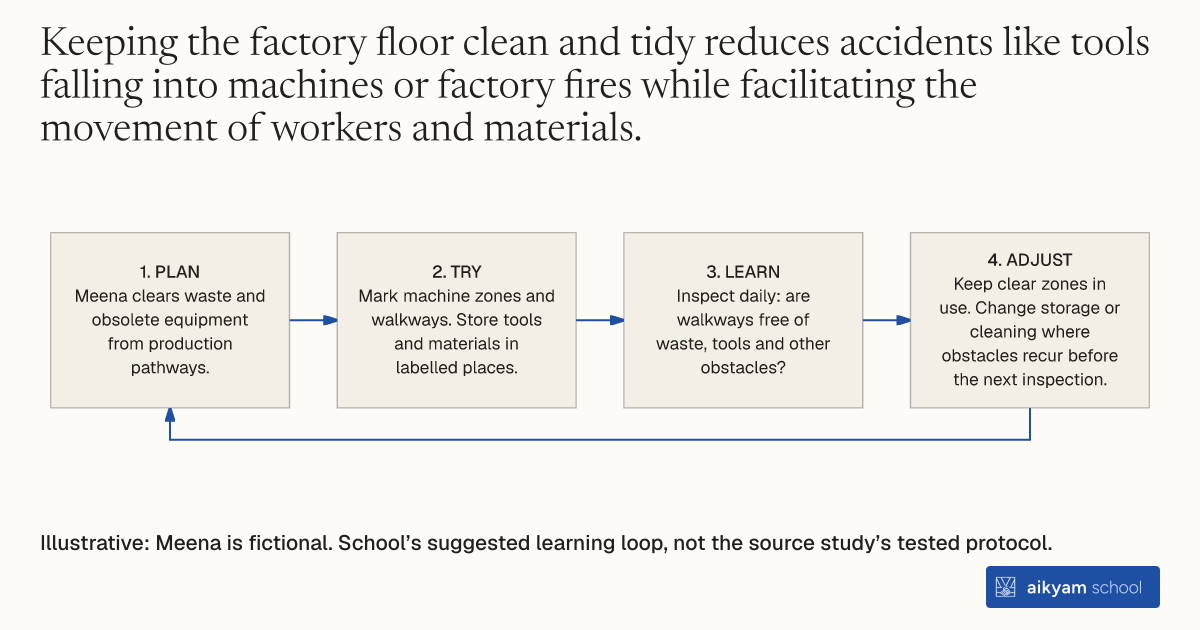
- Plan: Meena clears waste and obsolete equipment from production pathways.
- Try: Mark machine zones and walkways. Store tools and materials in labelled places.
- Learn: Inspect daily: are walkways free of waste, tools and other obstacles?
- Adjust: Keep clear zones in use. Change storage or cleaning where obstacles recur before the next inspection.
Illustrative: Meena is fictional. School’s suggested learning loop, not the source study’s tested protocol.
See source →Observe clear walkways, designated storage and floor waste. School suggests this learning loop; it is not the source’s tested procedure.
How
When to use
Factory floors in manufacturing plants are frequently dirty, cluttered with garbage, obsolete equipment, and scattered tools. This disorder blocks worker movement, causes accidents, slows material transit, and damages raw materials. This method helps plant managers organize production spaces, clear waste, and mark designated walkways and machine zones.
Clear factory floors of waste, delineate machine zones and walkways, and establish daily cleaning routines to optimize material flow and factory safety.
- Production staff clear factory floors of garbage, old warp beams, threading equipment, and obsolete furniture obstructing pathways.
- Maintenance workers mark out designated locations for each machine and demarcate clear walkways across the shop floor.
- Factory workers store tools, spare parts, and materials strictly in labeled, designated zones rather than leaving them on the floor.
- Floor supervisors conduct daily inspections to ensure walkways remain free of waste, tools, and physical obstacles.
Example
International consultants guided workers at woven cotton textile plants near Mumbai, India to clear clogged factory floors and mark machine boundaries, helping raise floor cleanliness adoption from 7.1% to 28.5% across treatment plants.
About the study
Participants
28 plants across 17 large, family-owned cotton textile firms in Tarapur and Umbergaon near Mumbai, India, averaging 273 employees and $7.45 million in annual sales per firm.
Study Design
Randomized controlled trial providing 11 treatment firms with 5 months of management consulting and 6 control firms with 1 month of diagnostic consulting, measuring outcomes weekly across ~100 weeks.
Results
Organizing shop floors and implementing lean practices contributed to a 9.4% increase in output (p = 0.026) and a 16.6% increase in total factor productivity (p = 0.061), while floor cleanliness adoption in treatment plants increased by 21.4 percentage points.