In Simple Words
Imagine a taxi driver who never changes the engine oil or checks tire pressure, choosing instead to drive the car until the engine explodes on the highway. Fixing the blown engine costs ten times more money and loses three days of fares, whereas taking thirty minutes every month to change the oil would keep the car running smoothly without unexpected breakdowns.
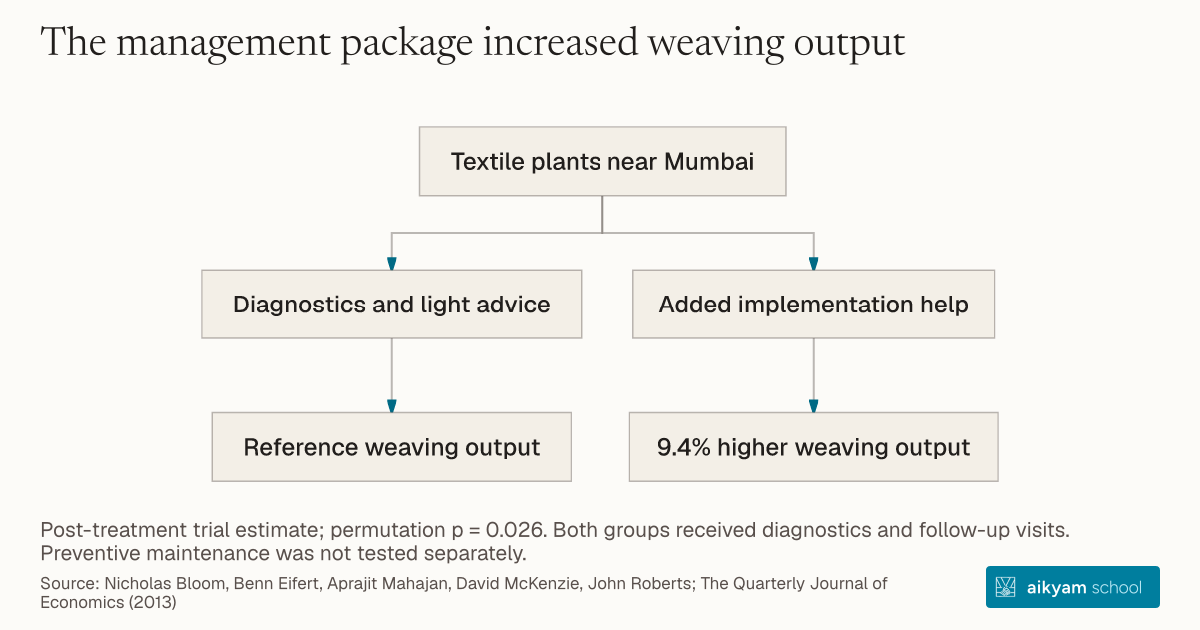
Textile plants near Mumbai
- Diagnostics and light advice
- Reference weaving output
- Added implementation help
- 9.4% higher weaving output
Post-treatment trial estimate; permutation p = 0.026. Both groups received diagnostics and follow-up visits. Preventive maintenance was not tested separately.
See source →Research question
Unmanaged manufacturing plants rely on run-to-failure machine maintenance strategies, causing sudden production stoppages, severe fabric defects, and excessive emergency repair costs.
Participants
28 manufacturing plants across 17 cotton textile woven fabric firms in Tarapur and Umbergaon, India.
Study Design
Randomized controlled trial tracking daily machine downtime logs, breakdown cause categorization, and scheduled maintenance protocols over ~100 weeks per plant.
Results
Baseline adoption of manufacturer-recommended preventive maintenance was only 7.1% in treatment plants; adopting regular preventive maintenance and logging breakdown causes contributed to reducing machine downtime and raising fabric weaving output by 9.4%.
Takeaway
Create a daily machine breakdown log categorized by fault type and implement manufacturer-recommended scheduled preventive maintenance routines across all critical plant equipment.
Source and citation
See source →Read alongside the research
Plain-English glossary
Original explanations, informed by the references below. Examples are illustrations, not data from the studies above. The research text stays unchanged.
- Baseline
The starting measurements in a study. Researchers use these to compare what participants were like at the start with what happens later.
ExampleBefore a training programme starts, researchers measure workers’ earnings. That first measurement is the baseline.
GET-IT glossary · Baseline characteristics ↗Read more about baseline →- Randomized controlled trial
A study that uses chance, like drawing lots, to decide who receives each option being compared. Researchers compare the groups’ outcomes to estimate the effect of those options.
ExampleA lottery assigns volunteers to a training programme or a comparison group. Researchers then compare their outcomes.
GET-IT glossary · Randomized study ↗Read more about randomized controlled trial →