Try, learn and adjust
Check temporary cash reaches eligible households
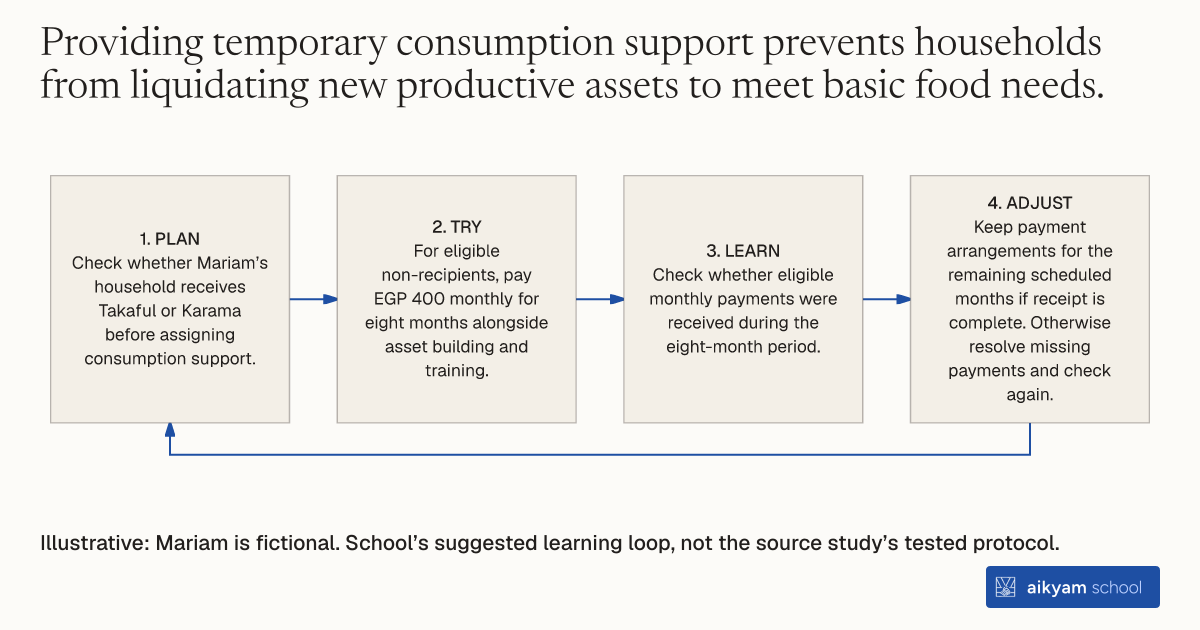
- Plan: Check whether Mariam’s household receives Takaful or Karama before assigning consumption support.
- Try: For eligible non-recipients, pay EGP 400 monthly for eight months alongside asset building and training.
- Learn: Check whether eligible monthly payments were received during the eight-month period.
- Adjust: Keep payment arrangements for the remaining scheduled months if receipt is complete. Otherwise resolve missing payments and check again.
Illustrative: Mariam is fictional. School’s suggested learning loop, not the source study’s tested protocol.
See source →School’s suggested, untested loop: observe eligibility and payment receipt; this component was evaluated within a graduation bundle.
How
When to use
Ultra-poor households entering a graduation program often face immediate food insecurity while establishing new livelihoods. Short-term cash transfers stabilize daily consumption during this transition phase. This method serves ultra-poor rural families who do not receive state social cash transfers.
Provide temporary monthly cash transfers to ultra-poor graduation participants to cover immediate living needs while enterprises mature.
- Screen participating ultra-poor households for enrollment in government assistance programs.
- Identify target households not receiving national Takaful or Karama cash transfers.
- Disburse EGP 400 in monthly consumption cash transfers directly to eligible households.
- Maintain monthly cash transfers for an 8-month duration alongside asset building and training activities.
Why it works
It gives families financial relief while their new micro-enterprises begin generating steady earnings.
Example
In Assiut and Sohag governorates, non-recipients of Takaful or Karama enrolled in the Bab Amal program received EGP 400 per month for 8 months. At the 40-month endline, beneficiary households sustained higher monthly food expenditure (up to EGP 1,286 versus EGP 1,172 in control) and significant reductions in food insecurity.
About the study
Participants
3,465 ultra-poor households in rural villages of Assiut and Sohag governorates, Upper Egypt.
Study Design
Randomized controlled trial evaluating graduation program arms against a control group across 20-month midline and 40-month endline surveys.
Results
Monthly food expenditure reached EGP 1,217 in full-cost unrestricted and EGP 1,286 in half-cost at endline compared to EGP 1,172 in control; food insecurity index decreased by 0.12 standard deviations in full-cost arms and 0.08 standard deviations in half-cost arm.