Try, learn and adjust
Check teamwork during a simulated order
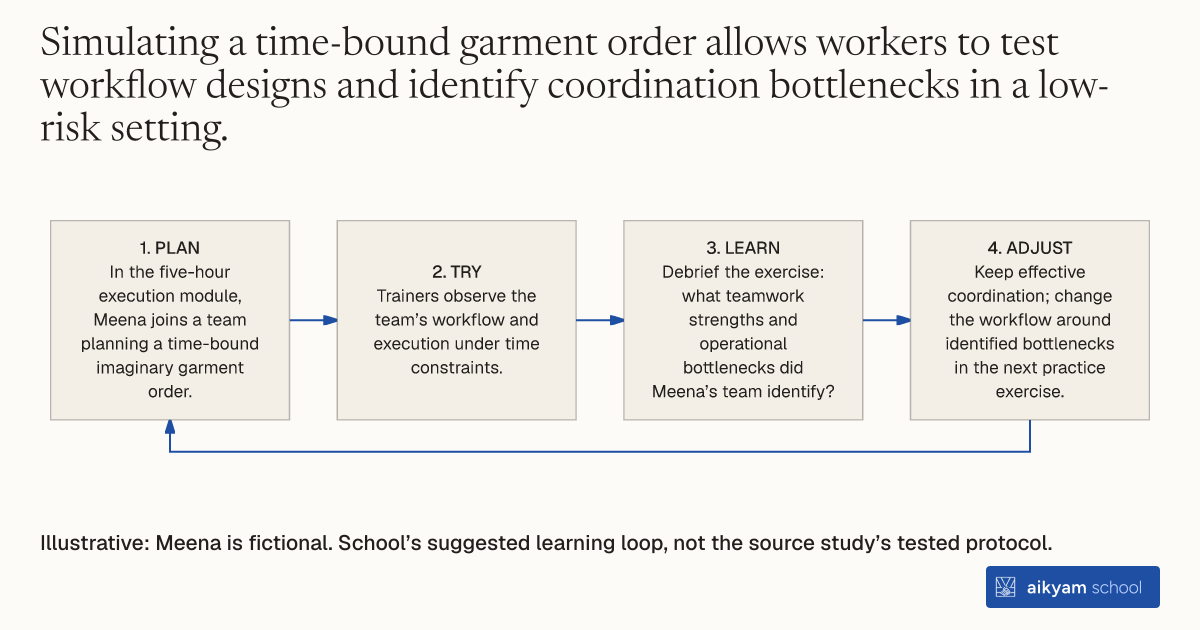
- Plan: In the five-hour execution module, Meena joins a team planning a time-bound imaginary garment order.
- Try: Trainers observe the team’s workflow and execution under time constraints.
- Learn: Debrief the exercise: what teamwork strengths and operational bottlenecks did Meena’s team identify?
- Adjust: Keep effective coordination; change the workflow around identified bottlenecks in the next practice exercise.
Illustrative: Meena is fictional. School’s suggested learning loop, not the source study’s tested protocol.
See source →School’s suggested learning loop, not a tested protocol. Observe trainer feedback, teamwork and workflow bottlenecks, not a separate module effect.
How
When to use
Frontline factory workers often lack structured experience with time-bound team coordination and end-to-end order execution, leading to quality defects and unmanaged operational delays. Poor internal motivation and disorganized workflow processes hinder team-based task execution. Deliver a five-hour execution excellence module using simulated garment order planning and trainer-led debriefings to build team execution capabilities.
Deliver five hours of structured execution excellence instruction using simulated order planning, observed team execution, and reflective debriefing sessions.
- Facilitate an introductory classroom discussion on internal motivation, attention to quality, teamwork, and effective workflow processes.
- Form small teams of workers and assign them a simulated, time-bound garment order planning exercise.
- Observe teams as they structure workflow processes and execute the simulated garment order under time constraints.
- Lead a reflective debriefing session immediately following the exercise where workers evaluate their teamwork strengths and operational bottlenecks.
- Provide structured trainer feedback on workflow organization, time management, and task coordination.
- Conduct a closing discussion linking high-quality task execution and internal motivation to long-term career growth and customer satisfaction.
Why it works
Immediate debriefing and trainer feedback solidify effective teamwork habits, improving motivation, attention to detail, and execution quality on the shop floor.
Example
A garment export enterprise delivered the 5-hour Execution Excellence module to 1,087 female factory workers across 5 plants in Bengaluru, India. Workers completed simulated order planning exercises and structured debriefings, contributing to an 85 to 110 percent post-module test score improvement and a 10.8 percentage point increase in daily production efficiency across factory lines.
About the study
Participants
2,703 female garment workers across 112 production lines in 5 export garment factories in Bengaluru, India.
Study Design
Two-stage randomized controlled trial measuring pre- and post-module test scores and daily worker efficiency using tablet computers following a 5-hour Execution Excellence module.
Results
Execution Excellence test scores increased by approximately 85 to 110 percent between pre- and post-module assessments, contributing to an overall 10.8 percentage point efficiency gain (p < 0.05) and a 0.201 standard deviation increase in grit (p < 0.05) among trained workers.