Try, learn and adjust
Check attendance-linked salary rules
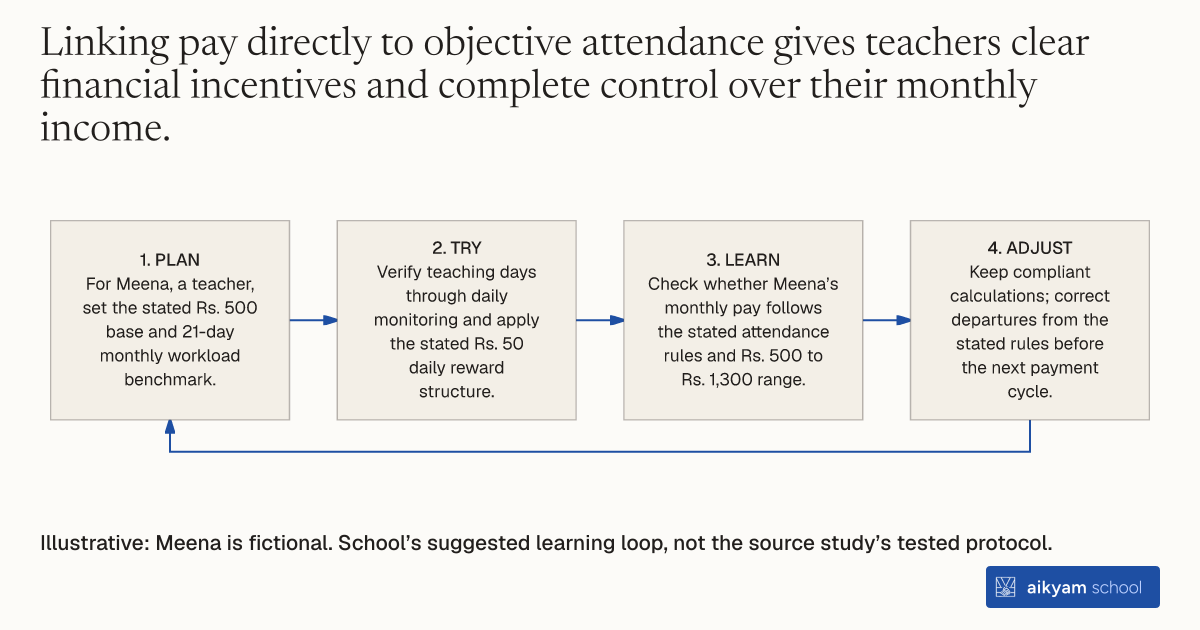
- Plan: For Meena, a teacher, set the stated Rs. 500 base and 21-day monthly workload benchmark.
- Try: Verify teaching days through daily monitoring and apply the stated Rs. 50 daily reward structure.
- Learn: Check whether Meena’s monthly pay follows the stated attendance rules and Rs. 500 to Rs. 1,300 range.
- Adjust: Keep compliant calculations; correct departures from the stated rules before the next payment cycle.
Illustrative: Meena is fictional. School’s suggested learning loop, not the source study’s tested protocol.
See source →School’s suggested learning loop, not a tested protocol. Observe verified teaching days, the workload benchmark and the stated pay rules.
How
When to use
Rural informal schools with flat fixed monthly pay face high rates of teacher absenteeism because teachers earn the same amount regardless of attendance. Fixed compensation without financial consequences or rewards fails to motivate regular physical presence. A sliding salary structure ties earnings directly to actual days taught to encourage daily attendance.
Structure teacher compensation with a lower base pay and a daily performance reward linked to attendance.
- Lower the fixed base salary guaranteed to teachers to Rs. 500 per month.
- Establish 21 days of teaching as the baseline expectation for a standard monthly workload.
- Pay teachers a financial bonus of Rs. 50 for each valid day taught as verified by daily monitoring.
- Allow monthly pay to vary dynamically between Rs. 500 and Rs. 1,300 based on verified attendance days.
Why it works
This automatic structure eliminates supervisor discretion and ensures transparent rewards for showing up.
Example
In rural Udaipur, India, Seva Mandir replaced a fixed salary of Rs. 1,000 per month for 21 days with a Rs. 500 base pay plus Rs. 50 per day taught, causing monthly pay to range from Rs. 500 to Rs. 1,300 and average pay to equal original levels while teacher absenteeism dropped to 21 percent.
About the study
Participants
Single-teacher informal schools run by Seva Mandir in rural Udaipur, India, serving about 20 students each.
Study Design
Randomized controlled trial comparing teachers paid under a sliding salary structure linked to camera attendance against a control group paid a fixed salary of Rs. 1,000 for 21 days.
Results
Teacher absence dropped from 42 percent in the control group to 21 percent in the camera incentive group, completely eliminating extreme delinquency where teachers were absent more than half the time.