Try, learn and adjust
Check clinician videos before distribution
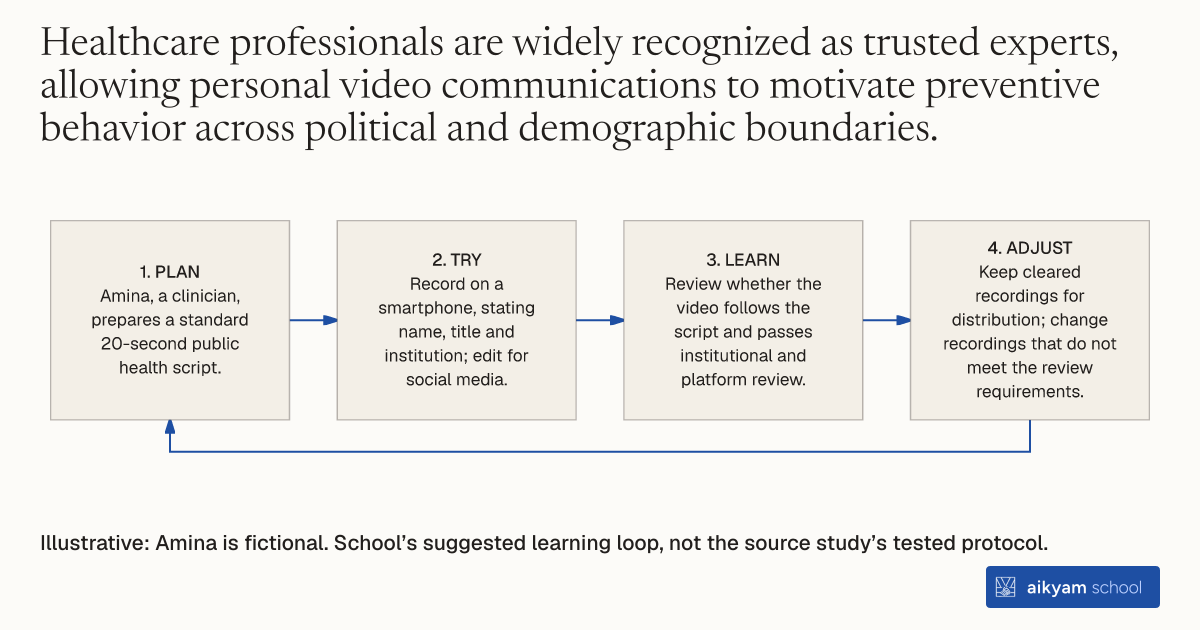
- Plan: Amina, a clinician, prepares a standard 20-second public health script.
- Try: Record on a smartphone, stating name, title and institution; edit for social media.
- Learn: Review whether the video follows the script and passes institutional and platform review.
- Adjust: Keep cleared recordings for distribution; change recordings that do not meet the review requirements.
Illustrative: Amina is fictional. School’s suggested learning loop, not the source study’s tested protocol.
See source →School’s suggested learning loop: Observe script adherence, video length and review clearance before distribution. This check does not establish campaign effects.
How
When to use
Public health agencies face increasing difficulties communicating urgent guidance during widespread disease outbreaks. Centralized guidance often struggles to overcome public distrust and behavioral inertia. Direct messaging from trusted healthcare professionals provides an accessible way to communicate preventive behaviors to wide populations.
Record short public health advisory videos using smartphones featuring diverse practicing clinicians.
- Recruited doctors and nurses record 20-second public health video messages on personal smartphones, stating their title, name, and institution.
- Clinicians deliver concise, standardized scripts encouraging preventive choices such as staying home during high-risk holiday periods.
- Production teams edit and standardize video recordings into short-form ad formats suitable for social media distribution.
- Sponsoring organizations clear recorded videos through institutional and platform policy review processes prior to campaign deployment.
Example
Six clinicians recorded 20-second smartphone videos before Thanksgiving and nine clinicians recorded before Christmas, reaching 11,954,109 Facebook users at Thanksgiving and 23,302,290 users at Christmas across 13 US states.
About the study
Participants
6,998 zip codes across 820 counties in 13 US states, reaching over 34 million total Facebook users.
Study Design
Two-stage cluster randomized controlled trial comparing high-intensity and low-intensity counties and zip codes receiving targeted Facebook video ads.
Results
Average holiday travel distance decreased by 0.993 percentage points (P = 0.002) in high-intensity counties, and zip code COVID-19 infections declined by 3.5% (P = 0.013) 5 to 19 days post-holiday.