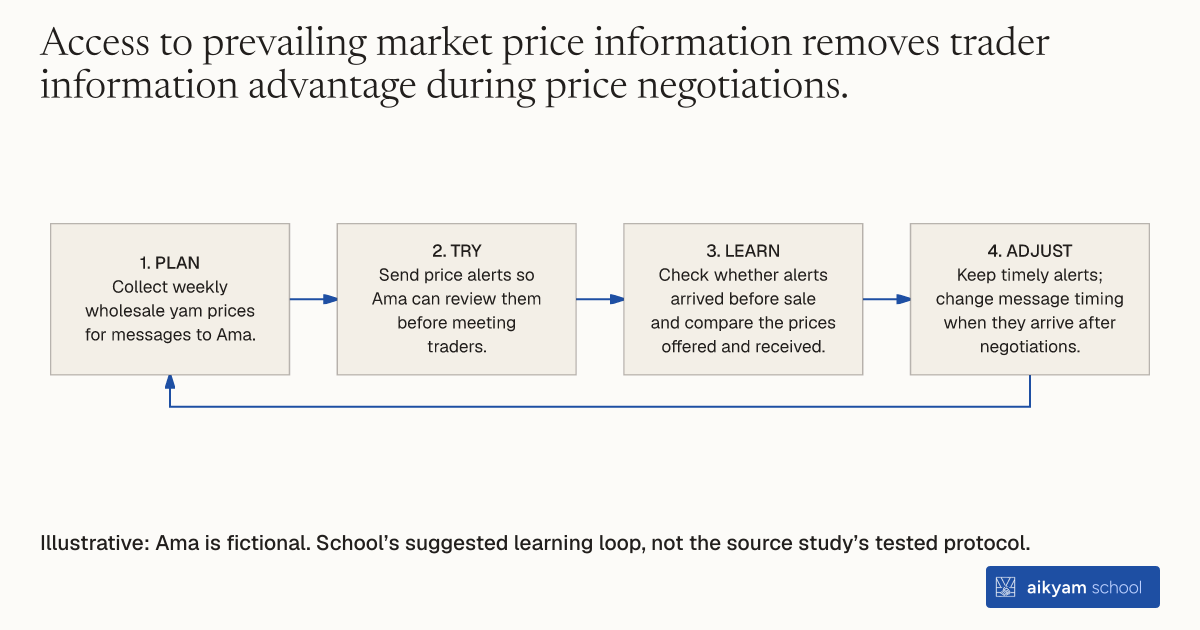
Try, learn and adjust
Check weekly price alerts before crop sales
- Plan: Collect weekly wholesale yam prices for messages to Ama.
- Try: Send price alerts so Ama can review them before meeting traders.
- Learn: Check whether alerts arrived before sale and compare the prices offered and received.
- Adjust: Keep timely alerts; change message timing when they arrive after negotiations.
Illustrative: Ama is fictional. School’s suggested learning loop, not the source study’s tested protocol.
See source →Observe alert receipt, sale timing and prices; do not assume a price increase. School suggests this learning loop; it was not tested by the source.
How
When to use
Asymmetric price information leaves smallholder farmers unaware of current market rates for high-variability crops. Visiting traders exercise market power to offer low farmgate prices to uninformed producers. This method helps agricultural projects deliver regular SMS price feeds to smallholders to strengthen their bargaining power during sales negotiations.
Broadcast weekly market price updates via SMS to smallholder farmers before sales transactions with local traders.
- Extension service managers collect weekly wholesale crop prices from local agricultural markets.
- Program operators compile current market price reports for targeted high-variability crops like yams.
- Extension systems automatically send weekly price alert text messages to registered smallholder farmers' mobile phones.
- Smallholder farmers receive and review market price alerts prior to meeting visiting traders.
- Farmers use the price data during sales negotiations to bargain with traders for fairer farmgate prices.
Why it works
Farmers leverage accurate market benchmarks to reject low offers and secure better sale prices for their produce.
Example
In Ghana, providing smallholder farmers with weekly price alerts via SMS resulted in a 9 percent increase in yam prices received in the first year relative to a comparison group. The intervention generated revenue returns equal to over 200 percent of implementation costs, which cost about US$51 per farmer in 2011.
About the study
Participants
Smallholder yam farmers in rural Ghana.
Study Design
Randomized controlled trial evaluating the impact of weekly SMS market price alerts on farmgate prices received by smallholders versus a comparison group.
Results
Weekly SMS price alerts resulted in a 9 percent increase in yam prices received by farmers in the first year, driven by increased bargaining leverage, and generated revenue returns equal to over 200 percent of implementation costs (service cost about US$51 per farmer in 2011).