Try, learn and adjust
Check community-focused recruitment materials
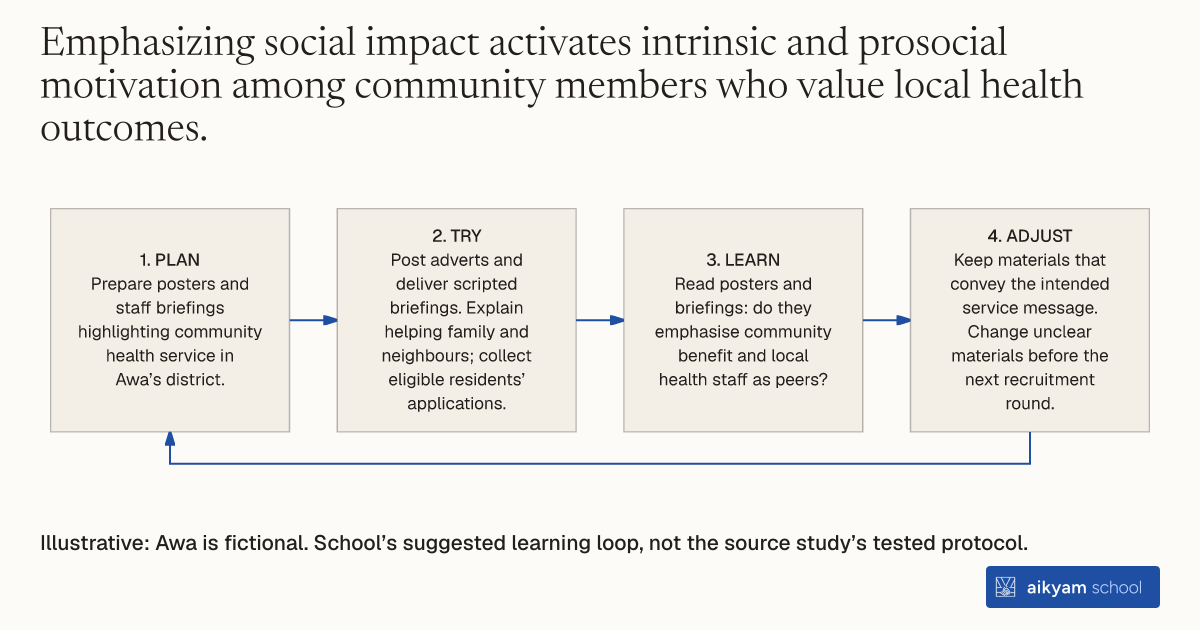
- Plan: Prepare posters and staff briefings highlighting community health service in Awa’s district.
- Try: Post adverts and deliver scripted briefings. Explain helping family and neighbours; collect eligible residents’ applications.
- Learn: Read posters and briefings: do they emphasise community benefit and local health staff as peers?
- Adjust: Keep materials that convey the intended service message. Change unclear materials before the next recruitment round.
Illustrative: Awa is fictional. School’s suggested learning loop, not the source study’s tested protocol.
See source →School’s suggested, untested loop. Observe recruitment wording and applications; this does not establish worker retention or health effects.
How
When to use
Public organizations need to recruit community-based health workers in rural areas where official civil service career incentives are absent or minimal. Standard recruitment drives risk low application rates or mismatches if social purpose is unclear to local candidates. Highlighting community impact and social service attracts local applicants with strong prosocial preferences and community connectedness.
Advertise public service roles using recruitment materials that emphasize community impact, altruistic service, and local collaboration.
- District health officials post printed advertisements in local public spaces including schools, churches, and community health posts.
- Recruitment posters emphasize helping family and neighbors prevent illness and list local health post staff as peers.
- District health officials read a scripted briefing to local health facility staff describing the position as an opportunity to serve local community health needs.
- Local health centers collect applications from residents aged 18 to 45 who completed Grade 12 secondary education with two O-level passes.
- Selection panels shortlist candidates based on community endorsements, Grade 12 examination scores, and previous experience as volunteer health workers.
Why it works
This attracts applicants who perceive a high alignment between personal identity and community welfare.
Example
The Ministry of Health in Zambia posted social-impact recruitment posters across 24 rural control districts for the Community Health Assistant program. The drive attracted 10.0 applicants per health post, with interviewed applicants scoring an average of 23.3 on Grade 12 O-level exams. Recruited workers completed an average of 319 household visits over 18 months and organized 20.32 community mobilization meetings.
About the study
Participants
1,585 interviewed applicants (68.4 percent farmers, average age 26.0, 30.4 percent female) across 24 control districts in rural Zambia where 4.3 percent of the population held secondary credentials.
Study Design
Randomized controlled trial across 48 districts stratified by province and literacy, comparing community-focused control posters emphasizing social impact to career-focused treatment posters.
Results
Social-impact control advertisements produced an average applicant exam score of 23.3 and prosociality score of 2.51. Recruited workers achieved an 82.3 percent retention rate after one year and completed an average of 319.0 total household visits over 18 months.