Try, learn and adjust
Check the reporting campaign reaches citizens and candidates
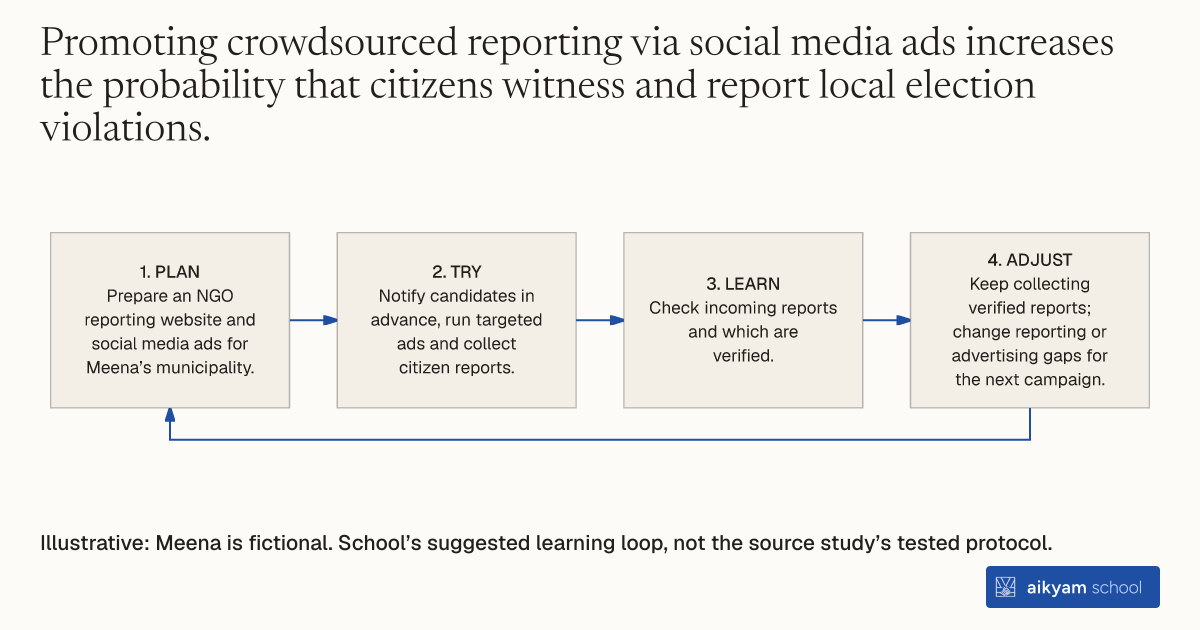
- Plan: Prepare an NGO reporting website and social media ads for Meena’s municipality.
- Try: Notify candidates in advance, run targeted ads and collect citizen reports.
- Learn: Check incoming reports and which are verified.
- Adjust: Keep collecting verified reports; change reporting or advertising gaps for the next campaign.
Illustrative: Meena is fictional. School’s suggested learning loop, not the source study’s tested protocol.
See source →Ad delivery, candidate notification and verified reports; no assumed deterrence. School’s suggested learning loop, not a source-tested cycle.
How
When to use
Candidates and local political actors engage in electoral irregularities during local campaigns. Civil society organizations lack sufficient official observers to detect widespread local election violations. This method enables citizen oversight across target municipalities to document noncompliance and deter political actors from malpractice.
Launch targeted Facebook advertising campaigns urging citizens to report election irregularities on a dedicated non-governmental organization platform.
- Create a secure online reporting website managed by a non-governmental organization to accept citizen reports of electoral irregularities.
- Design public service advertisements for social media platforms promoting citizen oversight and explaining how to submit reports.
- Target social media ad campaigns to registered voters within selected municipalities prior to local elections.
- Notify local election candidates in advance that a crowdsourced reporting campaign is active in their municipalities.
- Collect and aggregate incoming citizen reports of election irregularities through the central website.
- Publish or share verified reports to increase public transparency and deter candidate malfeasance.
Why it works
Notifying candidates in advance amplifies this effect by signaling a higher threat of public detection, which deters politicians from attempting irregularities.
Example
During the 2019 mayoral elections in Colombia, researchers ran a large-scale Facebook ad campaign encouraging citizens to report election irregularities via an NGO website; citizens in targeted municipalities filed more reports, which reduced electoral irregularities and decreased the vote share of candidates engaging in them.
About the study
Participants
Registered voters and mayoral candidates across municipalities in Colombia during the 2019 mayoral elections.
Study Design
Randomized field experiment evaluating the effect of targeted Facebook ad campaigns encouraging citizen irregularity reporting, combined with candidate pre-notification.
Results
Increased citizen reporting of electoral irregularities, reduced overall electoral irregularities, decreased the vote share of candidates who engaged in irregularities, and produced larger deterrence effects where candidates were notified beforehand.