Research procedure
Deliver sponsored updates to news feeds
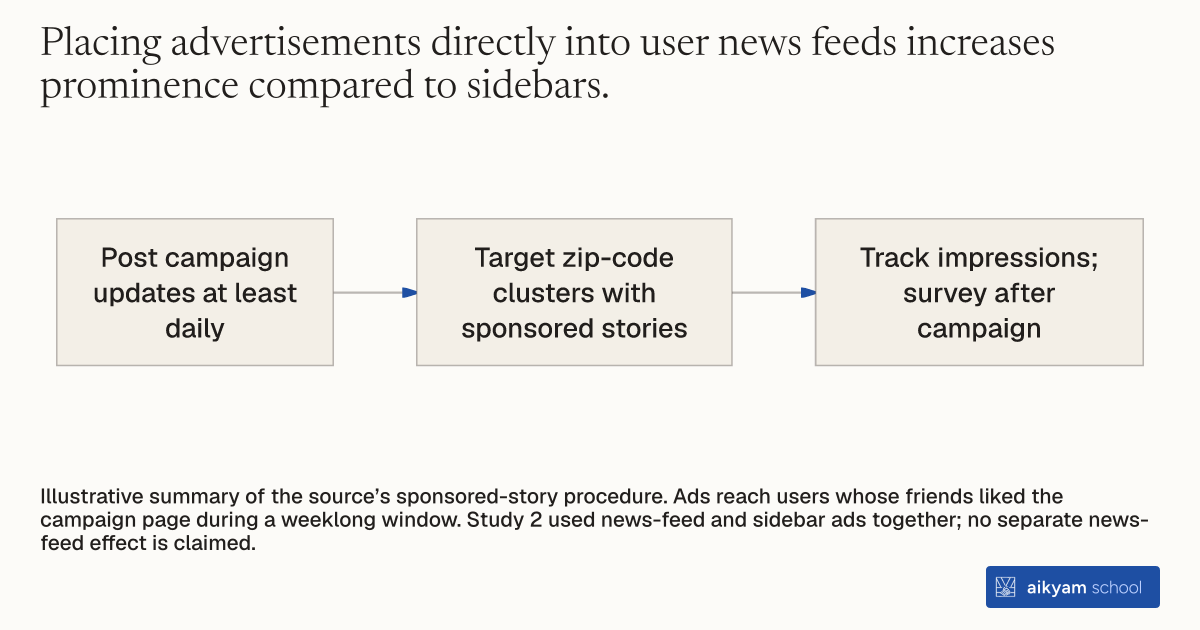
- Post campaign updates at least daily
- Target zip-code clusters with sponsored stories
- Track impressions; survey after campaign
Illustrative summary of the source’s sponsored-story procedure. Ads reach users whose friends liked the campaign page during a weeklong window. Study 2 used news-feed and sidebar ads together; no separate news-feed effect is claimed.
See source →How
When to use
Political campaigns need higher-visibility ad placement than standard sidebar banners. Displaying campaign messages directly within user news feeds alongside social endorsement signals solves low attention rates for traditional web ads. This method targets social media users whose friends already support the candidate.
Deliver sponsored updates directly into target users' main news feeds featuring social endorsements from connected friends.
- Publish candidate updates, campaign news, and event photos to a central social media campaign page at least once per day.
- Select target zip code clusters from voter registration records.
- Purchase sponsored story advertising placements that promote page updates to targeted users who have friends that already liked the page.
- Set an ad bid above market clearing rates to guarantee delivery into eligible user news feeds.
- Serve news feed advertisements continuously across a weeklong campaign window.
- Track impression volume and user recall through post-campaign automated telephone surveys.
Why it works
Displaying which friends like the campaign adds social proof that draws reader attention.
Example
A Democratic candidate for Congress ran sponsored story news feed ads and sidebar ads for seven days before an election, spending $0.80 per thousand impressions to deliver 3.98 million impressions to 108,783 users, increasing ad recall by 8.1 percentage points among Facebook users.
About the study
Participants
261,150 voters across 8 counties grouped into 752 zip code clusters, with 3,557 survey respondents matched to voter records.
Study Design
Clustered randomized field experiment blocking 752 zip code clusters into groups of four by size, assigning 25% of individuals to treatment and 75% to control, evaluated via an automated post-campaign phone survey.
Results
Exposure to ads increased recall of seeing online materials by 5.3 percentage points overall (95% CI [0.024, 0.088], p < 0.001) and 8.1 percentage points among Facebook users (95% CI [0.036, 0.126], p < 0.001), but had no significant effect on candidate name recognition (+1.1 percentage points, 95% CI [-0.036, 0.061]), favorability (+1.5 percentage points, 95% CI [-0.033, 0.067]), or issue recall (+2.2 percentage points, 95% CI [-0.024, 0.069]).