Research measurement
Assess restrictions on women’s mobility
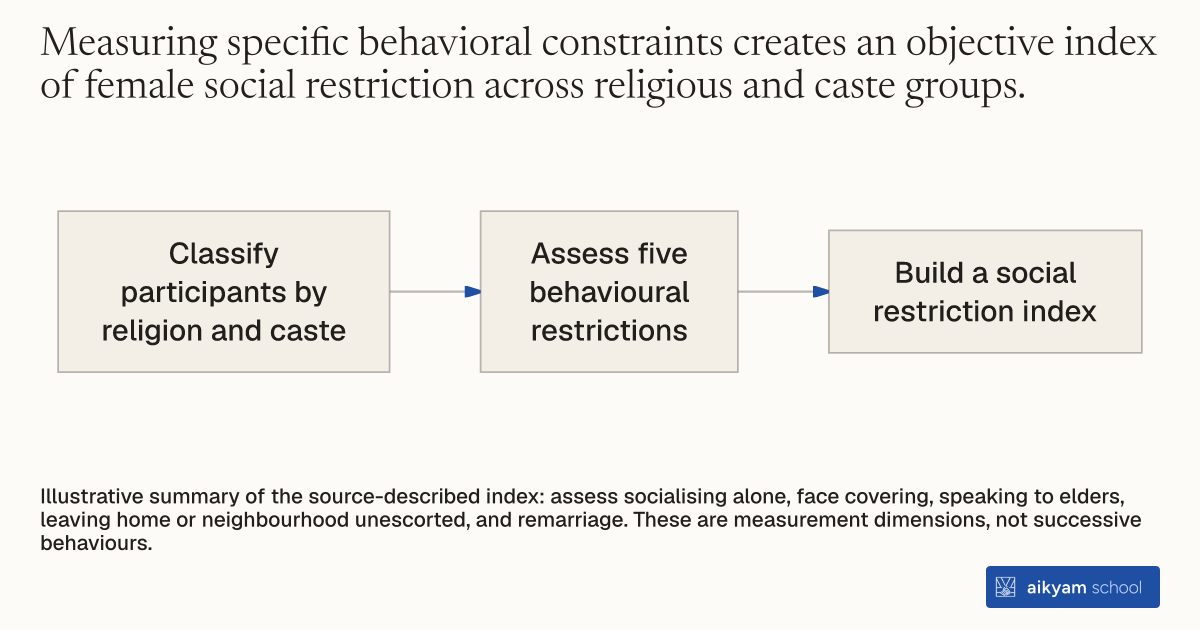
- Classify participants by religion and caste
- Assess five behavioural restrictions
- Build a social restriction index
Illustrative summary of the source-described index: assess socialising alone, face covering, speaking to elders, leaving home or neighbourhood unescorted, and remarriage. These are measurement dimensions, not successive behaviours.
See source →How
When to use
Women in developing countries face varying degrees of religious and caste restrictions that limit physical mobility and social interaction. Development programs need to assess how cultural rules restrict female participants before designing economic empowerment interventions. Evaluate baseline social constraints across demographic groups to target peer-supported programs effectively.
Assess female program participants across five distinct dimensions of behavioral mobility to construct a social restriction index.
- Categorize participating women by religious affiliation and caste background.
- Evaluate each participant's ability to socialize alone in public spaces.
- Record requirements regarding face veiling or covering one's face.
- Assess whether participants are permitted to speak directly to family elders.
- Measure freedom to leave the house or neighborhood unescorted and permission to remarry.
Why it works
Program designers can use this index to identify which groups face moderate versus extreme barriers to economic participation.
Example
Researchers evaluated 636 female SEWA Bank clients in Ahmedabad, India, across five mobility behaviors to construct a baseline social restriction index. The index showed that Muslim women faced the most severe restrictions, followed by upper-caste Hindu women, while scheduled-caste Hindu women faced the least restrictions.
About the study
Participants
636 female microfinance clients aged 18 to 50 in Ahmedabad, India.
Study Design
Quantitative social norm indexing across five behavioral dimensions within a randomized controlled field experiment.
Results
The index identified varying constraint levels across religious and caste groups, showing that peer-accompanied training produced the highest impact among upper-caste women who faced moderate social restrictions.