Research procedure
Observe group-created drama endings
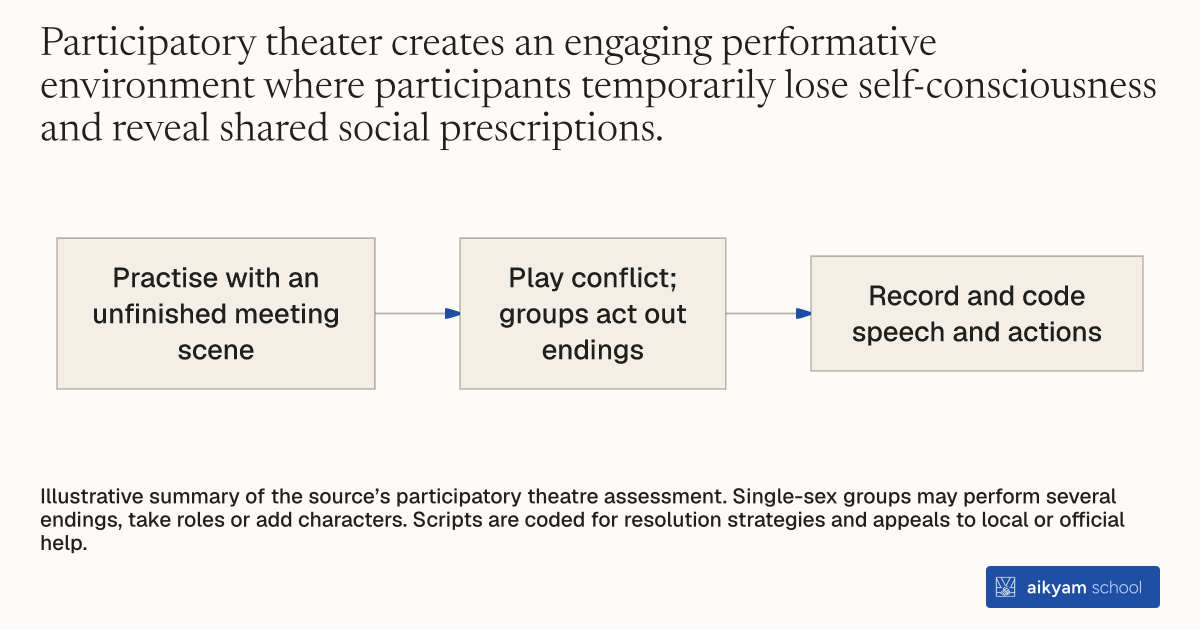
- Practise with an unfinished meeting scene
- Play conflict; groups act out endings
- Record and code speech and actions
Illustrative summary of the source’s participatory theatre assessment. Single-sex groups may perform several endings, take roles or add characters. Scripts are coded for resolution strategies and appeals to local or official help.
See source →How
When to use
Measuring group-generated social norms and collective problem-solving approaches in post-conflict settings presents methodological challenges. Direct questions or abstract surveys often induce social desirability bias and fail to capture interactive group dynamics. Participatory theater role-play exercises evaluate prescriptive community norms by having groups act out endings to realistic social dilemmas.
Conduct participatory drama role-play sessions by playing unfinished radio drama scenarios and recording group-generated endings.
- Form single-sex participant groups across study sites to ensure comfortable group deliberation.
- Play a practice recording of an unfinished community meeting scene to familiarize participants with the exercise format.
- Broadcast a recorded radio scenario depicting an escalating community conflict that cuts off at the climax.
- Invite group members to take on character roles, act as bystanders, or introduce new characters to resolve the dilemma.
- Record spoken turns and actions in script format while allowing groups to perform multiple ending variations.
- Code resulting scripts for problem-resolution strategies, reliance on local versus official aid, and use of public government rhetoric.
Why it works
Observing group-generated resolutions shows whether communities default to self-reliance or depend on external authority.
Example
In post-genocide Rwanda, 17 groups across eight research sites listened to an unfinished drama about a refugee crisis and performed 21 unique endings, yielding 359 coded lines of speech and action.
About the study
Participants
17 single-sex participant groups across 8 research sites in Rwanda, yielding 21 unique enacted scenes and 359 coded lines of speech and action.
Study Design
Exploratory performative field trial where groups listened to an unfinished recorded conflict about fleeing famine refugees, staged improvised endings recorded line-by-line in script format by two researchers, and were content-analyzed for resolution strategies and language use.
Results
Reconciliation drama listeners exclusively chose self-organized local resource sharing to support refugees (0 out of 21 resolution comments requested external aid), whereas control health listeners relied on government or NGO assistance in 16 of 21 resolution comments (p < 0.001), while 8% of comments across both conditions opportunistically utilized official government rhetoric.