Try, learn and adjust
Check fertiliser advice follows soil tests
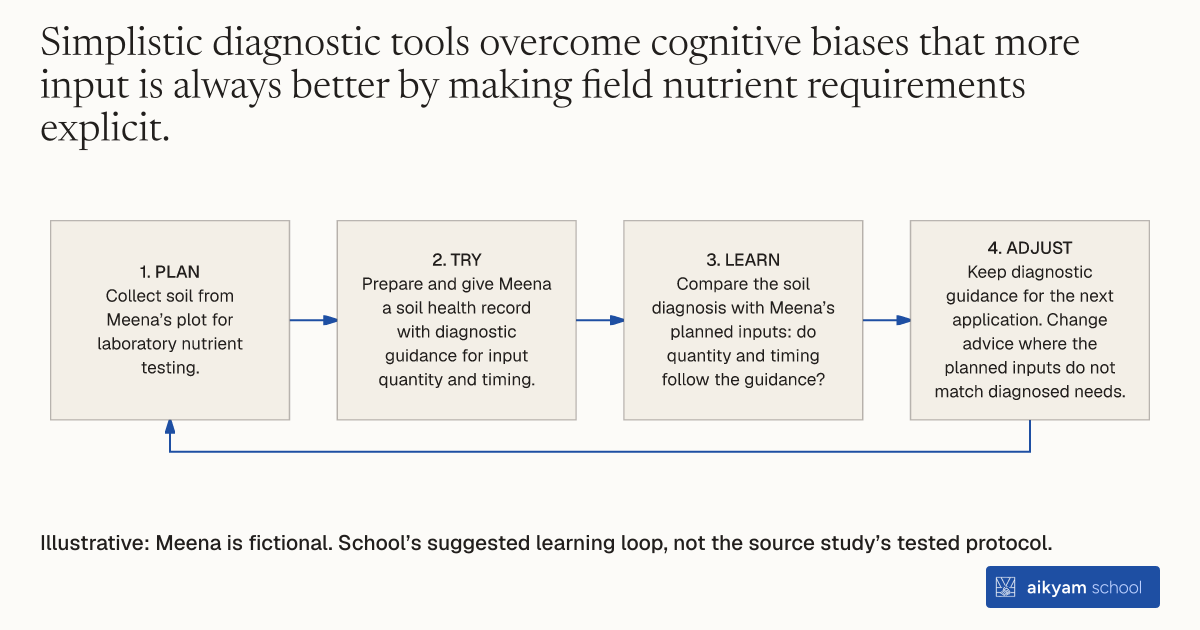
- Plan: Collect soil from Meena’s plot for laboratory nutrient testing.
- Try: Prepare and give Meena a soil health record with diagnostic guidance for input quantity and timing.
- Learn: Compare the soil diagnosis with Meena’s planned inputs: do quantity and timing follow the guidance?
- Adjust: Keep diagnostic guidance for the next application. Change advice where the planned inputs do not match diagnosed needs.
Illustrative: Meena is fictional. School’s suggested learning loop, not the source study’s tested protocol.
See source →School’s suggested, untested loop. Observe soil results, guidance and input plans. No fertiliser quantity or yield improvement is invented.
How
When to use
Heavy input subsidies can drive a behavioral bias among smallholders toward believing that applying more chemical fertilizer is always better. Overapplication wastes expensive inputs and fails to improve soil productivity or crop yields. This method provides smallholder farmers with diagnostic soil health cards to calibrate fertilizer quantities and timing to actual field requirements.
Distribute personalized soil health cards to farmers to calibrate chemical fertilizer quantity and application timing to soil diagnostic needs.
- Extension workers collect soil samples across target smallholder farm plots.
- Agricultural lab technicians test soil samples for essential nutrient levels and macro-nutrients.
- Extension officers compile test results onto simple, standardized soil health cards for each plot.
- Field agents distribute the soil health cards to participating smallholders during advisory meetings.
- Smallholders consult their soil health cards to apply optimal fertilizer quantities and timing based on diagnosed soil needs.
Why it works
Clear diagnostic guidance helps smallholders calibrate input quantities to optimal application levels.
Example
In India, researchers evaluated the distribution of simplistic diagnostic tools, including soil health cards, to smallholders receiving input subsidies. Providing farmers with soil health cards helped them overcome the behavioral bias toward overapplication and improved their knowledge of effective fertilizer management through optimal input quantity and application timing.
About the study
Participants
Smallholder farmers receiving agricultural input subsidies in rural India.
Study Design
Randomized evaluation assessing the impact of soil health cards on farmer knowledge and fertilizer management practices.
Results
Providing smallholder farmers with soil health cards improved their knowledge of effective fertilizer management through optimal fertilizer quantity and application timing, correcting behavioral biases toward overapplication.