Research steps
Distribute radios and audit retention
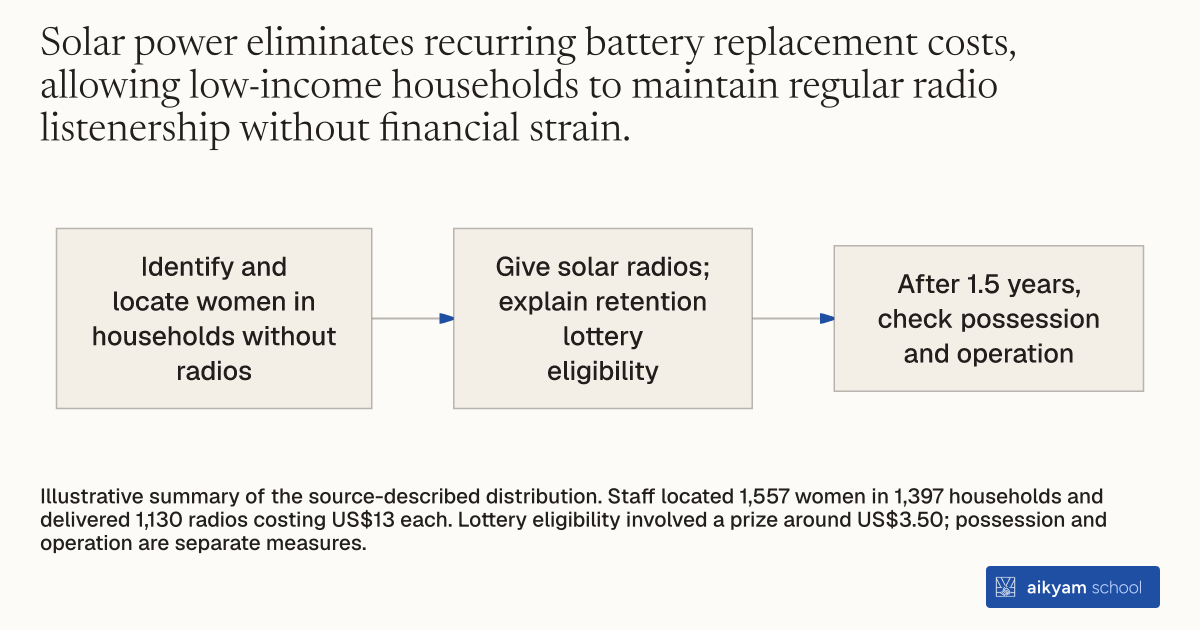
- Identify and locate women in households without radios
- Give solar radios; explain retention lottery eligibility
- After 1.5 years, check possession and operation
Illustrative summary of the source-described distribution. Staff located 1,557 women in 1,397 households and delivered 1,130 radios costing US$13 each. Lottery eligibility involved a prize around US$3.50; possession and operation are separate measures.
See source →How
When to use
In rural off-grid communities with low media penetration, households lack reliable access to health information because of the high cost of batteries and electricity. Program evaluators want to deliver exogenous mass media access to specific target populations, such as women of reproductive age. Distributing solar-powered radios directly to off-grid households provides sustained media exposure without creating financial battery burdens.
Distribute solar-powered radio receivers to randomly selected off-grid households without radio access to expand media exposure and health messaging reach.
- Identify households lacking radio access during baseline census surveys in target off-grid rural communities.
- Field staff track eligible women in targeted households between farming cycles when residents are present in villages.
- Distribute solar-powered radios costing 13 US dollars directly to targeted women to remove battery purchase barriers.
- Inform recipients that staff will return for a follow-up visit where households retaining their radios qualify for a cash lottery.
- Field teams conduct follow-up audits 1.5 years later to check radio operation, functional condition, and household retention.
Why it works
Combining direct targeting with a retention lottery incentivizes households to retain and use the device over extended evaluation periods.
Example
In rural Burkina Faso, field staff tracked 1,557 women across 1,397 households lacking radios and successfully presented 1,130 solar radios valued at 13 US dollars. Evaluators offered eligibility in a 3.5 US dollar cash lottery for retaining the device, achieving a 95 percent retention rate and a 62 percent functional operation rate after 1.5 years.
About the study
Participants
1,557 women in 1,397 households without radios across 252 rural off-grid villages in Burkina Faso.
Study Design
Individual and household-level randomized evaluation embedded within a two-level cluster RCT across 16 radio station broadcast zones.
Results
Radio distribution doubled household radio access from 32-34 percent to 68 percent, increased weekly radio listening by over 1 hour, and achieved 95 percent retention after 1.5 years.