Try, learn and adjust
Check which cookstove orders become purchases
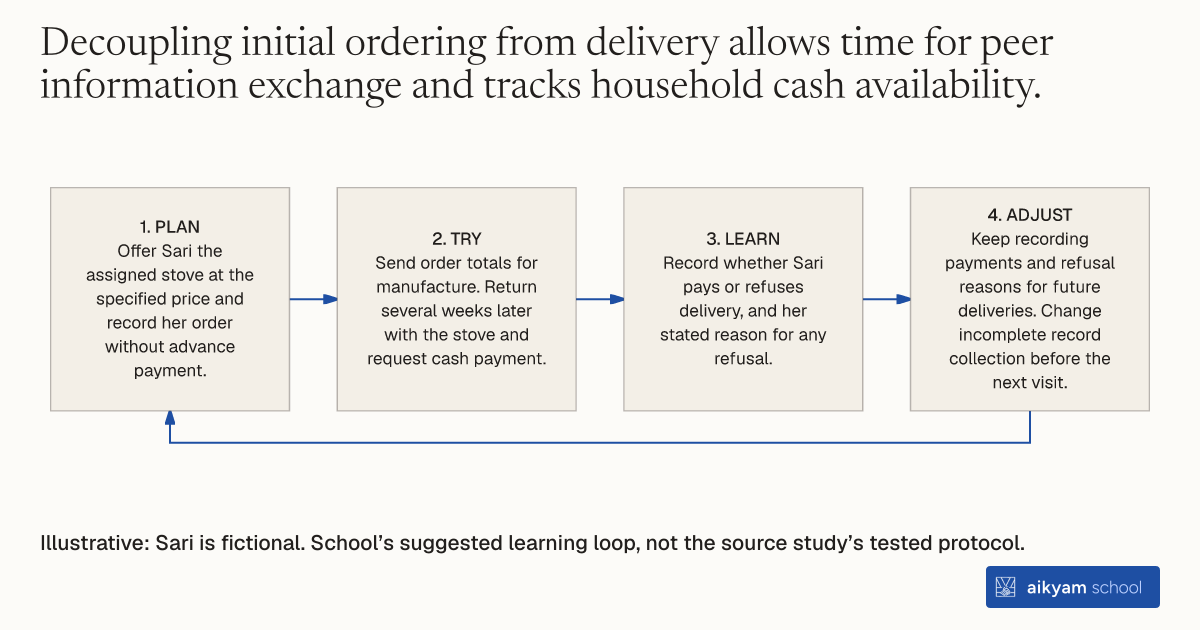
- Plan: Offer Sari the assigned stove at the specified price and record her order without advance payment.
- Try: Send order totals for manufacture. Return several weeks later with the stove and request cash payment.
- Learn: Record whether Sari pays or refuses delivery, and her stated reason for any refusal.
- Adjust: Keep recording payments and refusal reasons for future deliveries. Change incomplete record collection before the next visit.
Illustrative: Sari is fictional. School’s suggested learning loop, not the source study’s tested protocol.
See source →School’s suggested, untested loop. Observe orders, delivery payments and refusal reasons; an order is not a completed purchase.
How
When to use
Program managers face difficulty distinguishing between initial interest and final cash purchase when introducing new technologies. Measuring orders separately from final cash collection reveals point-of-sale liquidity constraints. Separating initial selection from final payment shows whether non-purchase stems from lack of interest or lack of cash on hand.
Separate technology ordering from product delivery to observe household purchase commitment and short-term cash constraints.
- Visit targeted households and offer assigned products at specified prices during initial marketing calls.
- Record initial purchase orders placed by household decision-makers without collecting cash upfront.
- Transmit tally totals to manufacturers to produce the requested units.
- Return to the households several weeks later to deliver manufactured products and request cash payment.
- Record completed cash transactions and document specific reasons provided by households that refuse delivery.
Why it works
Comparing initial orders against final purchases isolates short-term liquidity bottlenecks from general lack of product demand.
Example
Field marketers visited 2,280 Bangladeshi households in 2008 to record cookstove orders before returning weeks later to deliver products and collect cash. At full price, 23% ordered efficiency stoves and 31% ordered chimney stoves, but final cash purchases dropped to 5% and 2% due to delivery refusal caused by lack of cash on hand.
About the study
Participants
2,280 households across 42 rural villages in Hatiya and Jamalpur, Bangladesh.
Study Design
Two-stage experimental distribution tracking initial purchase orders against final cash transactions following a multi-week manufacturing lag between July 2008 and February 2009.
Results
Full-price initial order rates were 23% for efficiency stoves and 31% for chimney stoves, but final purchases dropped to 5% and 2%; a 50% price reduction reduced delivery refusal rates by 13.4 percentage points for efficiency stoves and 13.2 percentage points for chimney stoves.