Procedure
Solo business training
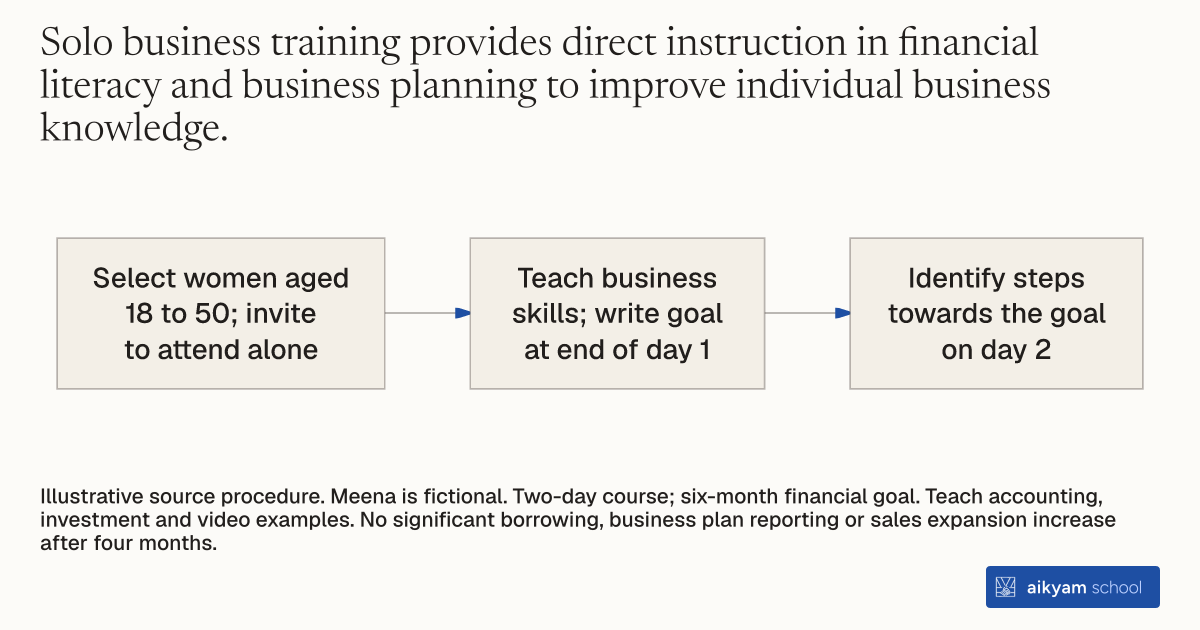
- Select women aged 18 to 50; invite to attend alone
- Teach business skills; write goal at end of day 1
- Identify steps towards the goal on day 2
Illustrative source procedure. Meena is fictional. Two-day course; six-month financial goal. Teach accounting, investment and video examples. No significant borrowing, business plan reporting or sales expansion increase after four months.
See source →How
When to use
Women entrepreneurs in informal urban markets often receive business and financial literacy training individually. Standard solo training aims to build business skills and financial knowledge among female microfinance clients. Evaluate solo training invitations when testing baseline business instruction without peer support mechanisms.
Deliver a standard two-day business training course to individual female microfinance clients without peer accompaniment.
- Select female participants between the ages of 18 and 50 from microfinance bank client rosters.
- Send invitations that instruct each selected participant to attend the two-day training course alone.
- Provide classroom instruction covering accounting skills, investment strategies, and aspirational video case studies.
- Direct participants to write down a six-month financial goal at the end of the first day of training.
- Instruct participants to identify steps to meet their six-month financial goals during the second day.
Why it works
However, without peer support, solo training fails to overcome social constraints on female mobility or stimulate loan demand and sales expansion.
Example
Researchers and the Self-Employed Women's Association Bank offered a two-day business training course to female clients in Ahmedabad, India. One-third of a sample of 636 women received invitations to attend the training course alone. Seventy percent of invited women attended the training, but four months later, women trained alone showed no significant increase in borrowing, business plan reporting, or sales expansion compared to uninvited women.
About the study
Participants
636 female microfinance clients aged 18 to 50 in Ahmedabad, India.
Study Design
Randomized controlled trial comparing individual training invitations against peer-accompanied training invitations and a non-invited control group.
Results
Women trained alone showed no significant increase in loan uptake, report of business plans, or sales expansion four months after training, though all trained women experienced an increase in labor hours worked.