Try, learn and adjust
Check delivery of summer workshops
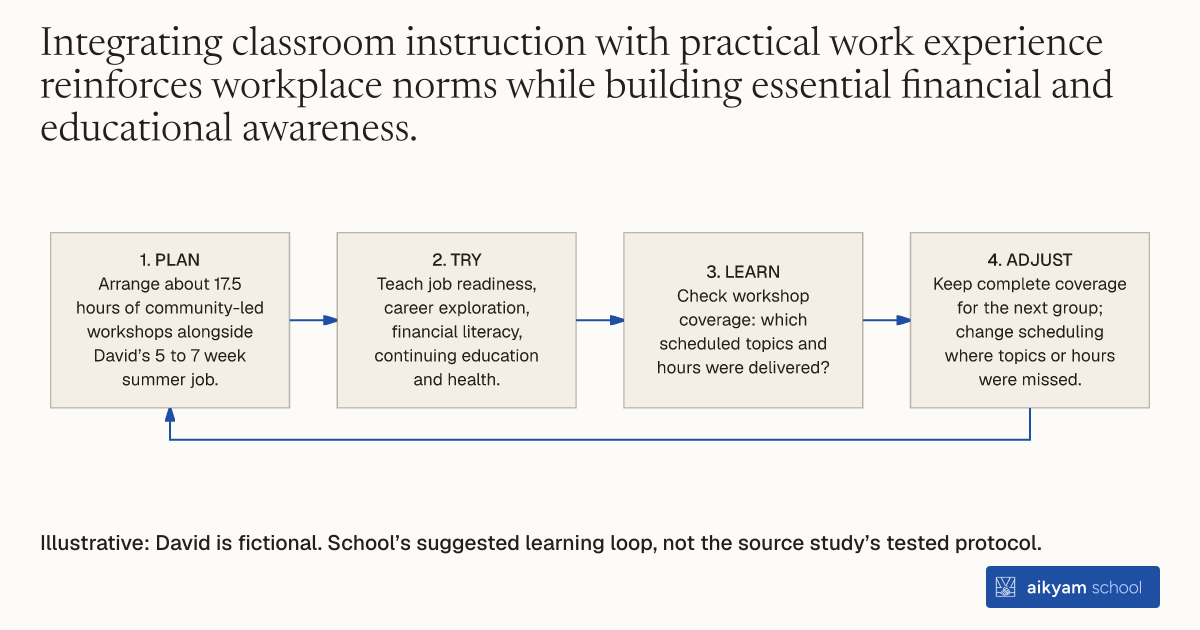
- Plan: Arrange about 17.5 hours of community-led workshops alongside David’s 5 to 7 week summer job.
- Try: Teach job readiness, career exploration, financial literacy, continuing education and health.
- Learn: Check workshop coverage: which scheduled topics and hours were delivered?
- Adjust: Keep complete coverage for the next group; change scheduling where topics or hours were missed.
Illustrative: David is fictional. School’s suggested learning loop, not the source study’s tested protocol.
See source →School’s suggested, untested learning loop. Observe workshop hours and topics; programme outcomes do not isolate the workshops’ effects.
How
When to use
Disadvantaged adolescents entering the labor market often lack basic career preparation, financial management skills, and knowledge of higher education pathways. Municipal summer youth employment programs need structured educational modules to complement hands-on work placements. These workshops equip young workers with foundational life and workforce skills.
Deliver structured educational workshops alongside subsidized summer employment through local community-based organizations.
- Contract with local community-based organizations to administer educational programming for youth participants.
- Schedule a total of approximately 17.5 hours of classroom instruction across the 5 to 7 week summer program.
- Teach core modules on job readiness and career exploration.
- Provide instruction on personal financial literacy and money management.
- Cover topics on continuing education opportunities and personal health.
Why it works
This dual approach helps young participants navigate both job responsibilities and future personal planning.
Example
In New York City's Summer Youth Employment Program, community-based organizations delivered about 17.5 hours of workshops on job readiness, financial literacy, career exploration, continuing education, and health to over 30,000 summer workers per year.
About the study
Participants
Over 30,000 youth per year ages 14–21 in New York City across the 2005–2008 program cohorts (average family income half the national average, ~50% Black).
Study Design
Randomized Controlled Trial (RCT) assigning lottery applicants to summer job placements with CBO workshops or control groups, tracking long-term outcomes through administrative incarceration, mortality, and tax databases.
Results
SYEP participation reduced the probability of serving prison time by 0.10 percentage points (a 10 percent reduction from the 0.99 percent baseline rate, translating to 112 fewer youth imprisoned) and reduced mortality by 0.073 percentage points (an 18 percent reduction from the 0.41 percent baseline rate, saving 83 lives).