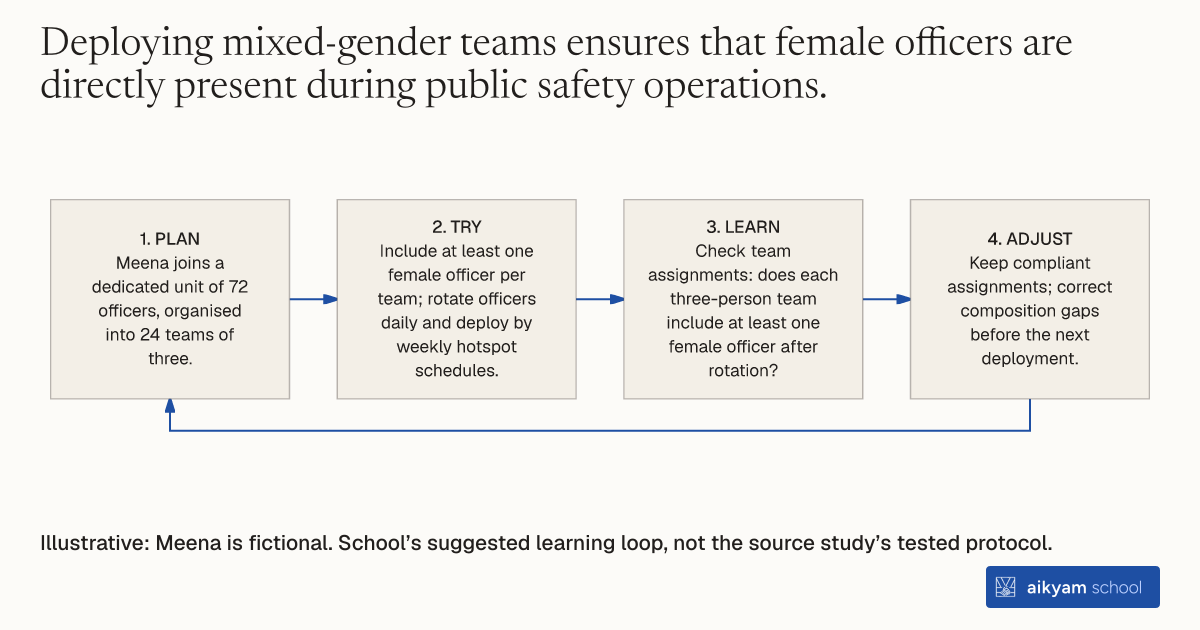
Try, learn and adjust
Check mixed-gender patrol team composition
- Plan: Meena joins a dedicated unit of 72 officers, organised into 24 teams of three.
- Try: Include at least one female officer per team; rotate officers daily and deploy by weekly hotspot schedules.
- Learn: Check team assignments: does each three-person team include at least one female officer after rotation?
- Adjust: Keep compliant assignments; correct composition gaps before the next deployment.
Illustrative: Meena is fictional. School’s suggested learning loop, not the source study’s tested protocol.
See source →School’s suggested learning loop, not a tested protocol. Observe team size, female-officer inclusion, daily rotation and weekly deployment assignments.
How
When to use
Urban women face widespread street harassment in public spaces, while traditional police forces often lack dedicated focus on gender-based crime. Establishing specialized units with mixed-gender teams addresses low public trust and ensures appropriate coverage. This operational structure supports targeted policing for municipal law enforcement agencies.
Structure a specialized law enforcement unit into small mixed-gender teams to target street harassment across public locations.
- Establish a dedicated public safety unit within the municipal police department, allocating 72 total officers.
- Divide the overall unit into 24 distinct operational teams of three officers each.
- Assign at least one female officer to every three-person team to ensure gender balance.
- Rotate officers daily across teams to maintain dynamic team composition.
- Deploy teams to designated public hotspots on weekly assignment schedules.
Why it works
This structure allows teams to effectively monitor public spaces and engage with citizens.
Example
Hyderabad City Police in Hyderabad, India, created the Safety, Health, and Environment Police Unit (SHE Teams) in 2014, structuring 72 officers into 24 three-member teams with at least one female officer per team.
About the study
Participants
72 officers in 24 teams deployed across 350 hotspots in Hyderabad, India.
Study Design
A randomized controlled trial evaluating the effectiveness of the SHE Teams task force structure across uniformed, undercover, and control hotspots.
Results
Structuring police into 24 three-member mixed-gender teams and deploying them in uniform reduced severe sexual harassment by 27 percent in patrolled hotspots compared to unpatrolled hotspots.